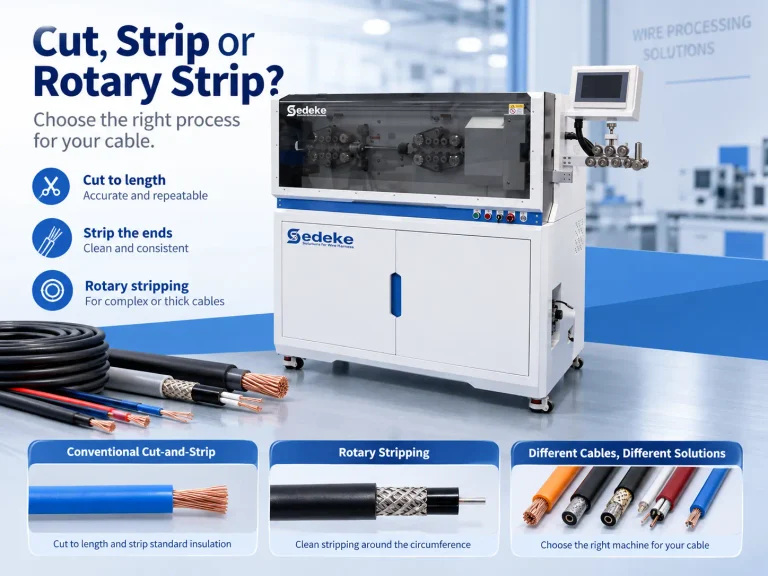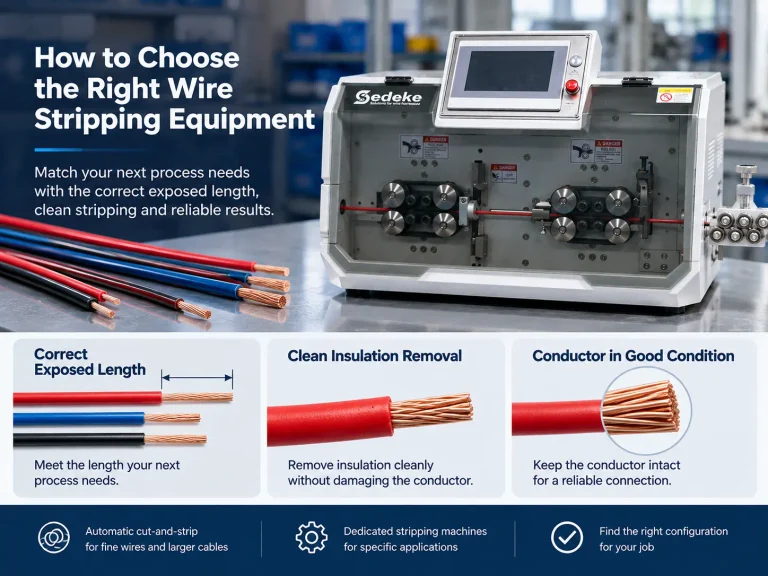


If you supply automotive wiring harnesses for European vehicle programmes, plan your next machine around the assemblies your customers have awarded and the work those assemblies require. A changing powertrain mix can increase demand for particular cable preparation tasks while leaving other operations with spare capacity.
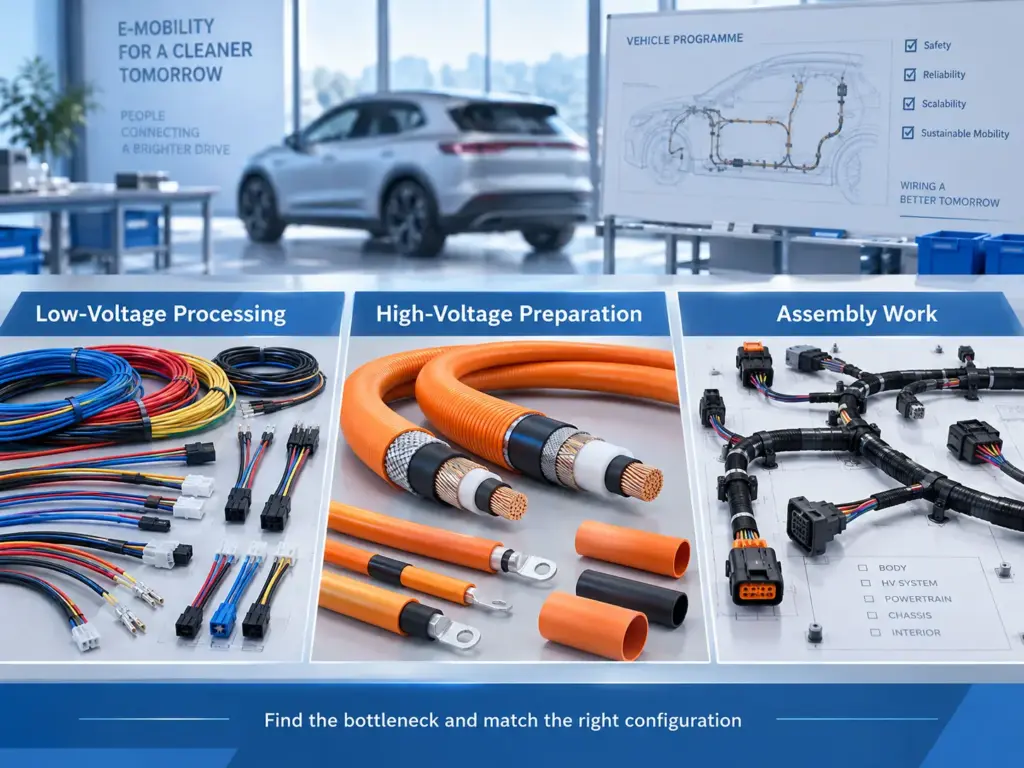
The practical starting point is to separate repeated low-voltage wire processing, high-voltage cable preparation and assembly work. Then compare each workload with the accepted output your plant can deliver. At Sedeke, our equipment range covers cutting, stripping, terminal crimping and selected high-voltage cable preparation operations. Bring us the operation that is holding up your programme, and we can discuss a machine configuration around the cable and finished part you need.

What European market data tells a harness manufacturer
The IEA’s Global EV Outlook 2026 reports 4.2 million electric car sales in Europe in 2025, equivalent to 28% of new car sales. Its electric-car category includes battery electric and plug-in hybrid cars. The regional figure provides context for suppliers serving European programmes; it is not a measure of wiring harness production.
A more recent EU snapshot shows why you should retain a mixed-powertrain view of the order book:
| EU new-car registrations, January to June 2026 | Share of registrations |
|---|---|
| Battery electric | 20.7% |
| Plug-in hybrid | 9.8% |
| Hybrid electric, including full and mild hybrids, excluding plug-in hybrids | 37.3% |
Source: ACEA’s first-half 2026 registration release, published 23 July 2026. These are selected categories, not the complete market split. They cover the EU, whereas the IEA figure above uses its broader Europe region and a different period. Do not combine the two datasets into a growth calculation.
ACEA’s downloadable statistical release defines the hybrid category and notes that current-year figures are provisional and may be revised.
For harness production, a shift towards electrified platforms can change the preparation sequence as well as the number of wires. TE Connectivity’s high-voltage cable assemblies for hybrid and electric vehicles illustrate shielded constructions and contact and shield crimping requirements. Where a new assembly introduces those features, plan the specified jacket removal and shield preparation alongside the tooling for its terminal family. Define End A and End B separately if their connectors require different strip lengths or retained layers. Keep existing low-voltage work in the schedule and let each assembly drawing determine the route; powertrain share alone does not establish it.
Connect the sales market to the factory you actually supply
Your customer’s sales territory, vehicle assembly plant and harness production location are three different fields. Record all three before allocating equipment expenditure to a European opportunity.
A registration in a European country does not tell you which factory assembled the car or which supplier received its harness order. For each programme, ask for the nominated receiving plant, delivery schedule, assembly part number, your supply allocation and the date production begins. If several plants share a platform, split their delivery requirements instead of treating the platform as one undifferentiated volume.
This produces a useful decision boundary. Awarded work can enter the committed capacity plan. A quotation request belongs in an opportunity scenario until the allocation is agreed. If the production location changes, revisit delivery frequency, buffer stock and which plant will own the equipment before repeating an earlier investment decision.

Turn programme volume into processing demand
Calculate demand in the same unit the proposed station produces:
Assemblies required = scheduled vehicles × your supply allocation × assemblies per vehicle.
For an end-preparation station, multiply by the number of ends that actually pass through that operation. A cable with two ends may need the same preparation at both ends, or different work at each end. Counting every cable as two identical operations can overstate the load.
Illustrative capacity calculation
Assume a monthly vehicle schedule of 20,000, a 40% supply allocation, one assembly per vehicle and 20 production days. These are planning assumptions, not market statistics or Sedeke test results.
| Calculation | Result |
|---|---|
| 20,000 vehicles × 40% × one assembly | 8,000 assemblies per month |
| 8,000 ÷ 20 production days | 400 assemblies per day |
| 400 × two ends requiring the operation | 800 prepared ends per day |
Now assume a trial demonstrates 900 accepted ends per shift on the actual job mix, and you plan one shift per day. The scheduled demand fits, with 100 ends of daily capacity remaining before any additional work is assigned. If the vehicle schedule rises to 25,000 under the same assumptions, demand becomes 1,000 ends per day and exceeds that trial output by 100.
Test the sensitivity to changeovers before treating that margin as spare capacity. In a simplified extension of this example, assume the 900 accepted ends require 450 productive minutes, or two ends per minute. Two additional changeovers taking 30 minutes each, including first-piece approval, leave 390 productive minutes and reduce output to 780 ends: 20 short of the 800-end requirement. This assumes an unchanged running rate and acceptance yield, and counts only time lost beyond the baseline schedule.
When shielded and unshielded jobs share a station, use a separate measured time per accepted end for each route. Add their processing times and changeover time, then compare the total with available shift time. A rate measured on unshielded wire cannot stand in for a sequence that also includes braid preparation. Use the resulting gap to compare another shift, a bottleneck improvement or another station.
Choose the investment that matches the change in your programme
| What changes | Your deciding check | Equipment-planning action |
|---|---|---|
| More volume on an unchanged wire and terminal family | Accepted output and unused capacity on the existing route | Compare added capacity for that established process |
| A new shielded high-voltage cable assembly | Required jacket, braid and inner-insulation preparation at each end | Scope the complete end-preparation sequence |
| More terminal variants at similar total volume | Batch length, tool changes and first-piece approval time | Compare mixed-job output before combining work on one machine |
| A revised harness layout or connector design | Assembly boundaries, access, handling and fixtures | Review the affected assembly operations as well as wire preparation |
Example: a mixed-platform programme for a European plant
Consider an illustrative order of 400 cable assemblies per day, with 100 requiring extra shield preparation at both ends. The shield operation therefore carries 200 ends per day, rather than the full programme’s 800 ends. If the existing cutting and stripping route still meets demand, compare a separate shield-preparation station first. If transfers and repeated loading make the shielded route miss its schedule, compare a replacement or expanded integrated preparation configuration against that same 200-end workload. Choose integration only when the trial covers every required step and the planned changeovers; an existing machine must have an approved upgrade path before you budget for a retrofit.
Check where the queue forms and whether End B still needs a second loading after End A is complete. Both can explain why a quoted cycle time fails to deliver the expected finished assemblies. Our wire harness assembly and automation guide covers the neighbouring operations when you need to trace that workload.
For repeated cutting, stripping and crimping at both ends
If your operators repeatedly move compatible wires between cutting, stripping and crimping stations, our ACC-102A terminal crimping machine is worth putting on the shortlist. It combines feeding, cutting, stripping and terminal crimping at both ends, giving you a route to reduce transfers between those operations. For a repeated wire-terminal family, that is a practical reason to compare an integrated Sedeke configuration with your current setup.
Build the comparison around the actual wire-terminal combinations and finished lengths. Include the tooling and changes required by the programme. If one end has a different termination, describe it separately so the proposed route accounts for the remaining work.
For high-voltage cable ends with braided shielding
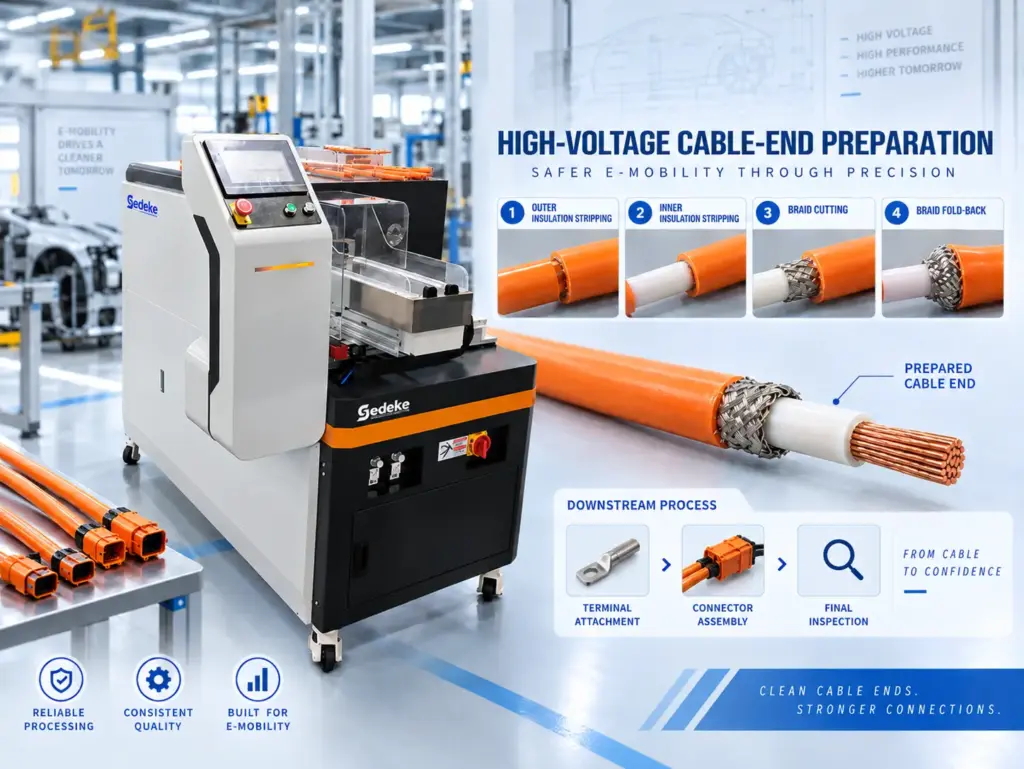
When shield preparation is the bottleneck, our HV-ACS 9300 high-voltage cable processing machine brings outer and inner insulation stripping, braid cutting and braid fold-back into one machine. This gives you a concrete option to compare with a route that splits those tasks across separate stations. Start with the finished cable end, and discuss the configuration that covers the preparation sequence your programme requires.
Provide an end drawing showing the retained layers and their finished positions. Allocate terminal attachment, connector assembly and final acceptance checks to the appropriate downstream stations. This lets you compare the complete preparation route rather than assuming that a stripped cable is a finished assembly.
Give equipment proposals the same acceptance boundary
For a European receiving plant, specify the installation site and required working language at the quotation stage. Ask each supplier to itemise the tooling, utilities, installation work, operator training, spare-parts arrangements and support scope included in the offer. Record these as quotation requirements so your team can compare the complete purchase.
Set the sample trial around a decision: can this configuration deliver the required accepted parts within the planned shift pattern? Include representative variants, both cable ends where applicable, normal handling and the required changeovers.
If the parts meet the drawing and the output meets the schedule, move to the commercial comparison. If quality passes but output falls short, identify the time loss and test the proposed correction. If the prepared end fails the drawing, resolve that issue before using the trial speed in your investment case.
Retain the sample identification, drawing revision, process settings and acceptance results together. Purchasing and production should be able to trace the quoted configuration back to the work it demonstrated.
FAQ
Can EU registration data be used for the whole of Europe?
Use the territory defined by the source. An EU series does not automatically cover the UK or other European markets. Keep the geography, period and powertrain category with each figure, and use the customer’s actual production schedule for plant-level planning.
Does a higher electric-car share mean every new machine should process high-voltage cable?
No. Decide from the assemblies you are contracted to supply. Low-voltage terminated wires and shielded high-voltage cables require different process routes, even when they are used in the same vehicle programme.
Should we invest before a customer confirms the order?
Separate committed production from opportunity scenarios. Identify which tooling or capacity is needed for existing orders and which expenditure depends on the new programme. This makes the effect of an award delay visible before you commit to expansion.
Which output figure should we compare across proposals?
Compare accepted parts over the same elapsed production period and job mix. Define whether the unit is a wire, an assembly or a processed end. Include the operations and handling needed to deliver that same output condition.
What should we send Sedeke first?
Send a cable photo or end drawing, the operation you want to improve and the target daily quantity. Add the installation country and the current bottleneck. We can use those details to discuss the relevant configuration and the application information needed next.
Discuss your European production programme with Sedeke
Whether you are increasing output on an established wire family or preparing a new high-voltage assembly, we can help you compare the relevant Sedeke equipment around that job. Start with a cable photo or drawing, the operation you want to improve and your target daily output. You do not need to choose a model before getting in touch.
Discuss your cable-processing requirement with Sedeke and take the next step towards a configuration and quotation matched to your production plan.