

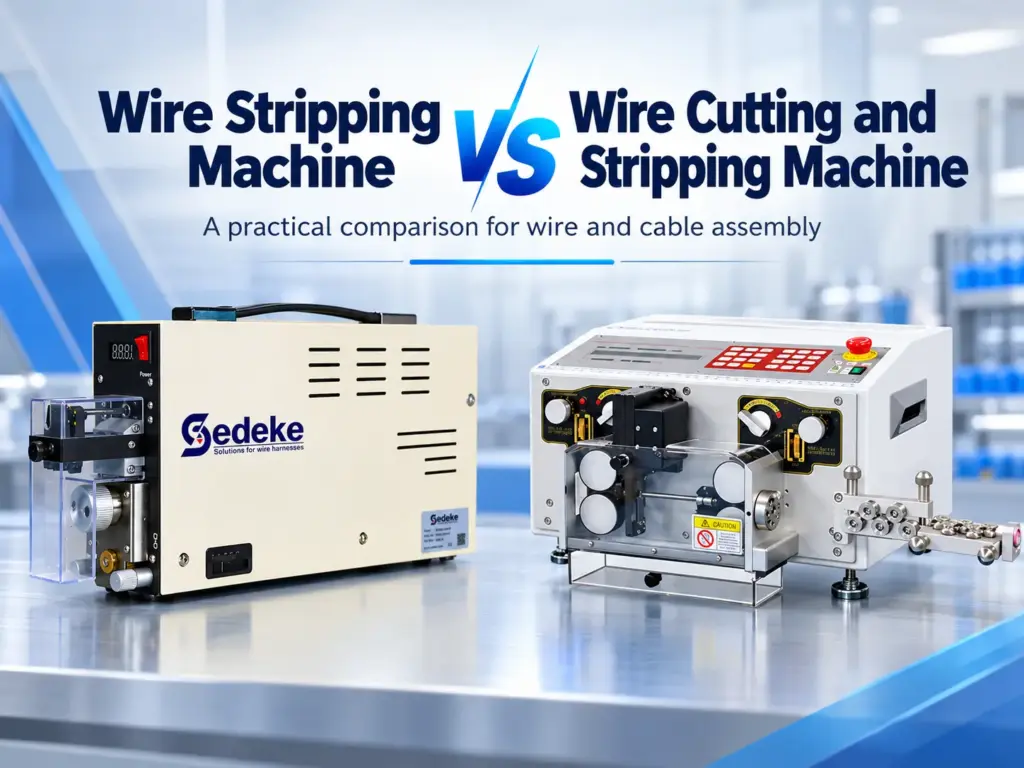
If your wire is already cut to length, a standalone wire stripping machine may be all you need. If you start with wire on a reel and need batches of cut, stripped leads, a wire cutting and stripping machine brings those operations into one process.
The buying decision comes down to where your production loses time. Are operators struggling to strip individual ends, or spending too much time measuring, cutting, moving and loading each wire? At Sedeke, we offer both types of equipment, so you can improve the step that slows you down without buying a machine that adds little to your workflow.
This comparison focuses on standalone wire-end strippers and reel-fed cut-and-strip machines for wire and cable assembly.
The main differences at a glance
| What you need to compare | Standalone wire stripping machine | Wire cutting and stripping machine |
|---|---|---|
| Starting material | Wire that has already been cut | Wire supplied from a reel or suitable feeding system |
| Main job | Remove insulation from an inserted wire end | Feed wire, cut it to the programmed length and strip the ends |
| Operator involvement | Load each end for stripping | Set up the wire and batch, then manage feeding and output |
| Finished wire length | Determined by the previous cutting operation | Set as part of the cutting program |
| Strongest fit | Pre-cut leads, varied assembly work and separate stripping stations | Repeated lead lengths and batch preparation |
| Main workflow benefit | Improve end preparation without replacing your cutting process | Reduce separate cutting, transfer and stripping steps |
| What to check first | Access to the wire end and the required strip | Wire feeding, length control, end preparation and collection |
Neither route replaces the need to check the finished wire. You still need the correct strip length, intact conductor strands and leads that fit the next assembly operation.
When a standalone wire stripping machine makes more sense
Choose a standalone stripper when cutting is already handled efficiently. You may receive pre-cut wire from a supplier, use an existing cutter, or prepare leads in small batches at an assembly bench. In these situations, replacing the entire preparation process may not solve your main problem.
A standalone machine lets you focus on the wire ends. Your operator inserts an end, runs the stripping cycle and moves to the next end or assembly step. This suits work where the order of operations changes, wires arrive in separate kits, or access to an individual conductor matters more than continuous reel feeding.
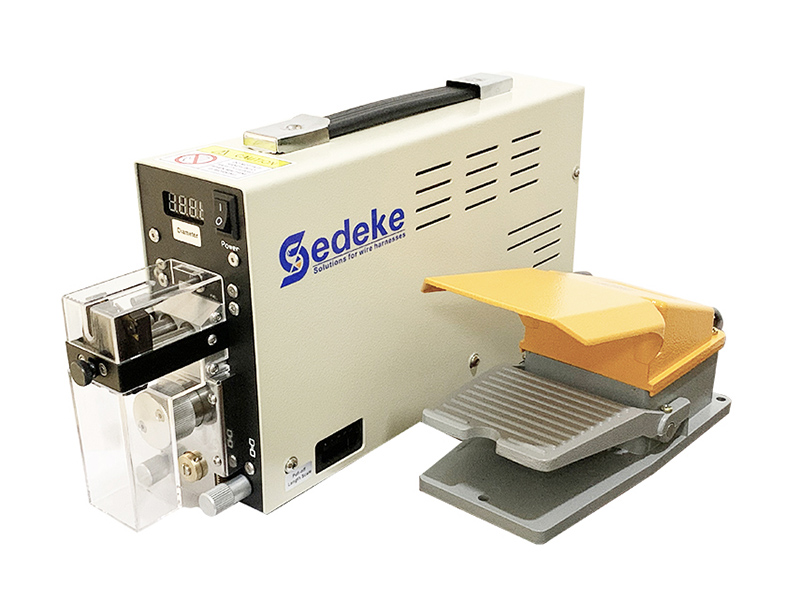
For example, our UniStrip 2018E electric wire stripping machine handles single conductors and the inner conductors of multicore cables. Wire insertion activates the stripping cycle through a sensor, with an optional foot pedal available. It supports a conductor cross-section range of 0.3–4 mm².
If you prepare multicore cable ends, think about the work after the outer jacket has been removed. The individual conductors may need stripping at an assembly station. A wire-end stripper can serve that job even when another machine handles the initial cable preparation.
The trade-off is repeated handling. If both ends need stripping, include loading and turning the wire in your production-time comparison. A fast stripping cycle does not remove those steps.
When a cutting and stripping machine is the better investment
A cut-and-strip machine becomes more useful when you repeatedly make leads from reeled wire. Instead of cutting a batch, moving it to another station and loading the ends separately, you program the finished length and stripping requirements in one setup.
That is a good route to consider when your operators spend more time preparing and transferring wire than assembling the finished product. It can also simplify batch preparation when the same lead specifications return regularly.
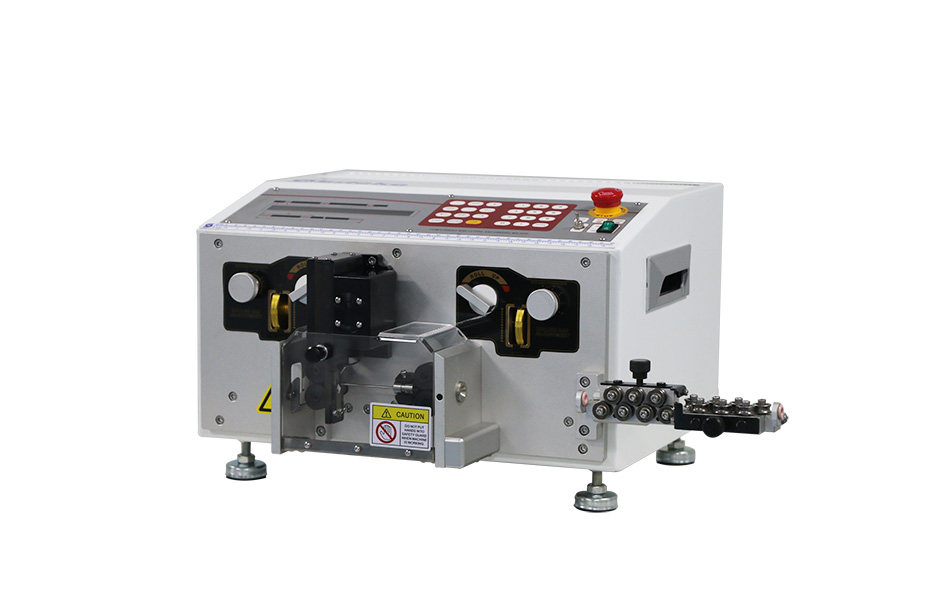
Our ESC-BX4 wire cutting and stripping machine is a roller-fed option for AWG 28–10 wire. It combines cutting and stripping and also offers intermediate stripping for jobs that need insulation removed away from the ends.
Start with your actual wire, not just its AWG size. The outside diameter, insulation material and required end pattern affect machine selection. Also plan what happens before and after the machine: how the reel pays out, how the wire enters the feed path and how finished leads are collected.
Long leads need particular attention. If the output falls into a tangled pile, your team may spend the time saved at the machine sorting wires afterward. Feeding and collection belong in the equipment discussion from the start.
Match the machine to your production job
You receive pre-cut wires for control-panel assembly
Keep the existing cutting arrangement if it delivers the lengths you need. A standalone stripper can improve end preparation close to the assembly bench. Compare how easily operators can switch between your common wires and position each end consistently.
There is little reason to add reel-fed cutting solely because it sounds more automated. Buy the operation your team is missing.
You make repeat batches of appliance or harness leads
If production starts with reels and repeats the same finished lengths, assess a cut-and-strip setup. Look at the complete batch: loading the reel, setting the job, checking the first pieces, processing the quantity and collecting the output.
This is where combining operations can make a practical difference. Your comparison should include the separate cutter and stripper you would otherwise need, along with the handling between them.
You process cables with several preparation stages
Shielded, coaxial and multicore cables may need more than ordinary end stripping. List the required operations separately: outer-jacket removal, shield work and inner-conductor preparation, for example.
Do not select a general-purpose machine simply because it accepts the cable diameter. Choose equipment around the cable construction and each preparation step. A combined machine for one stage and a separate stripping station for another may be the more useful arrangement.
Compare finished leads, not headline machine speed
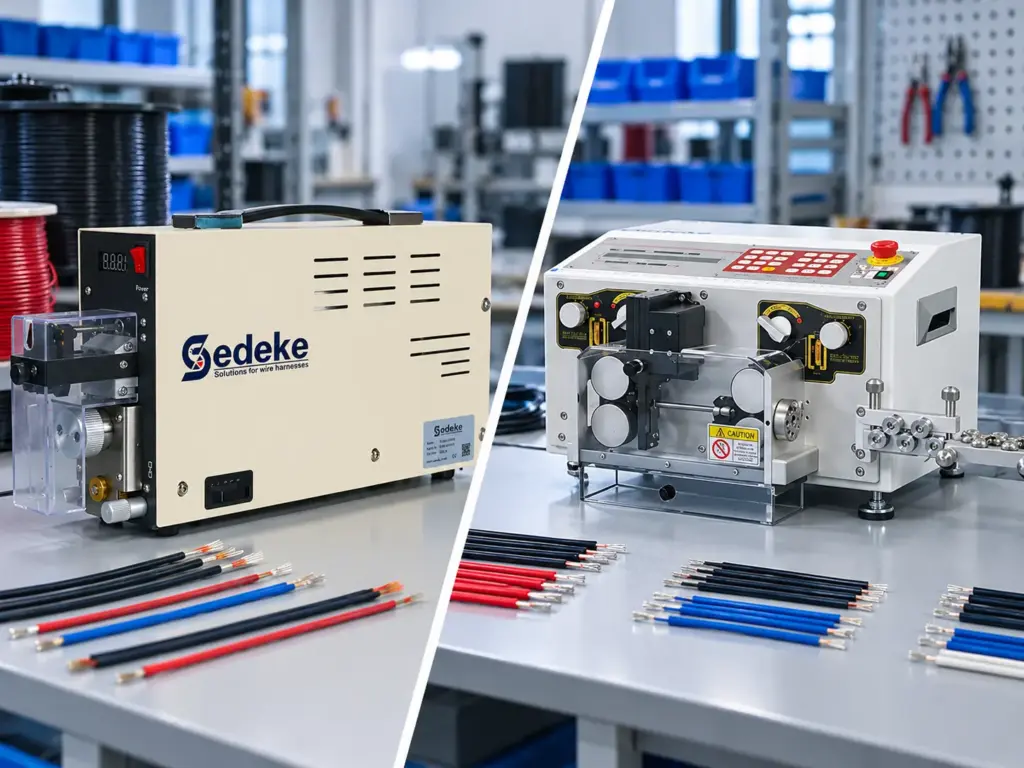
Ask each supplier to demonstrate the same wire and finished-lead requirement. Comparing a single-end stripping cycle with a complete cut-and-strip cycle will give you the wrong picture.
For a useful comparison, record:
- Setup time: how long it takes to change from your previous job to the next one.
- Accepted output: how many usable leads are completed over the same timed period.
- Operator handling: loading ends, turning wires, transferring batches and clearing output.
- End quality: strip length, remaining insulation and conductor condition.
- Downstream readiness: whether the leads can move directly to your crimping or assembly station.
Then compare the investment against the work you can actually remove. A standalone stripper can be the sensible purchase when your cutting process works well. A cut-and-strip machine deserves closer attention when separate preparation stages consume operator time every day.
There is no useful universal batch-size threshold for this decision. A long run of simple wire and a short run of difficult cable place different demands on equipment and operators. Your own recurring jobs provide a better basis for a quotation.
Can you use both types in the same workshop?
Yes. You do not have to replace every stripping station when you add a cut-and-strip machine.
You can use the combined machine for repeat reel-fed work and retain a standalone stripper for pre-cut leads, small assembly jobs or inner-conductor preparation. This keeps the main batch-preparation equipment available while other work continues at the bench.
If that matches your production mix, compare our wire stripping equipment with our cutting and stripping machines. The useful question is which jobs belong on each machine, not which category should replace the other.
Get a Sedeke quotation for the work you actually run
Tell us whether you start with reels or pre-cut wires, and share the wire size, finished length and stripping requirement. A photo of the wire and a typical finished lead is a helpful starting point if you are still putting the specification together.
We can recommend a suitable machine and provide a quotation around your production needs. We also offer sample testing, with test videos and result photos to help you assess the setup. English product manuals and installation and operating guidance are available to support your team.
Ready to compare the two routes? Contact Sedeke for a machine recommendation and quotation. Include your expected batch quantities so we can discuss the machine and feeding arrangement that fit your work.
FAQ
Does an automatic wire stripping machine always feed wire from a reel?
No. “Automatic” can describe the stripping cycle itself. A bench stripper may activate automatically when you insert a wire, while you still load each end by hand. Check how material enters the machine, not just the product name.
Can a wire cutting and stripping machine also crimp terminals?
Cutting and stripping do not include terminal crimping by default. If you want finished crimped leads, ask about a cut-strip-crimp configuration or the separate crimping equipment needed after wire preparation.
Can one machine strip both a multicore cable jacket and its inner wires?
Some equipment can handle several preparation tasks, but outer-jacket stripping and inner-conductor stripping are different jobs. Share the complete cable construction and end layout so the machine recommendation covers both stages.
What is partial stripping used for?
Partial stripping leaves the cut insulation section partly on the conductor rather than removing it completely. It can keep the strands covered until the next assembly step. Our UniStrip 2018E supports partial stripping; specify the result you need when requesting a setup.
Do I need to replace my existing wire cutter?
Not necessarily. If it already produces the lengths and quantities you need, adding a standalone stripper may be enough. Consider an integrated cut-and-strip machine when the transfer and repeated handling between separate operations become the problem.