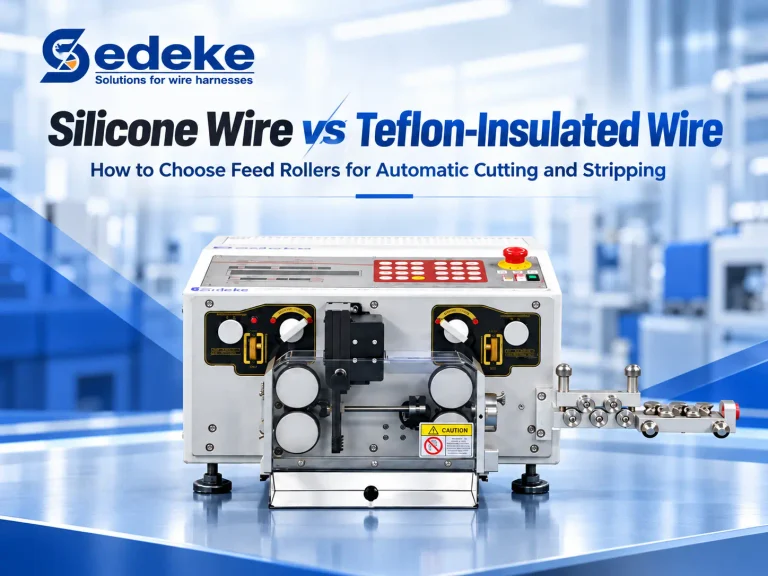


If you are buying an automatic wire cutter for silicone or Teflon-insulated wire, start with how the machine grips your material. A machine may cut to the right programmed length on one wire but leave roller marks, slip or feed unevenly on another. Choosing the right feed rollers matters as much as choosing the machine.
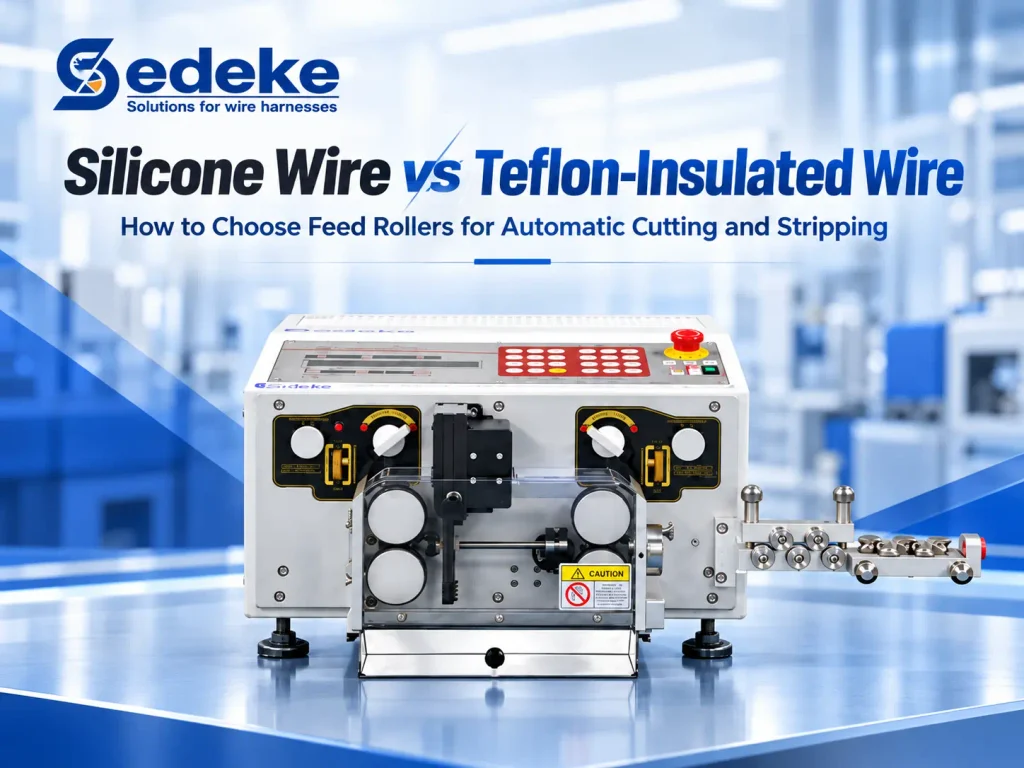
For single-conductor wire that needs both cutting and stripping, we recommend considering our Sedeke ESC-BX4. Its specified wire range is AWG 28–10 (0.08–5.26 mm²), and its roller-feed setup gives you a practical starting point for matching the machine to your insulation. Below, we explain when to use steel rollers, when rubber rollers deserve a closer look, and what to request with your quotation.
Why choose the Sedeke BX4 for cut-and-strip work?
An automatic wire cutter is not necessarily a wire stripping machine. If your next operation requires exposed conductor ends, choosing a cutting-only machine leaves you with another processing step.
Our ESC-BX4 wire cutting and stripping machine combines these operations. It is a useful model to shortlist when you want to prepare single-conductor wires from a continuous supply rather than cut them first and strip them separately.
The buying decision then becomes more specific: which roller setup suits your wire, and how should the machine be set for the finished lengths and stripped ends you need? Two wires with the same conductor size can behave differently when their insulation thickness, hardness or flexibility changes.
Start with your actual production wire, not just its AWG number. That gives us a better basis for recommending your BX4 configuration.
Steel or rubber rollers: which should you choose?
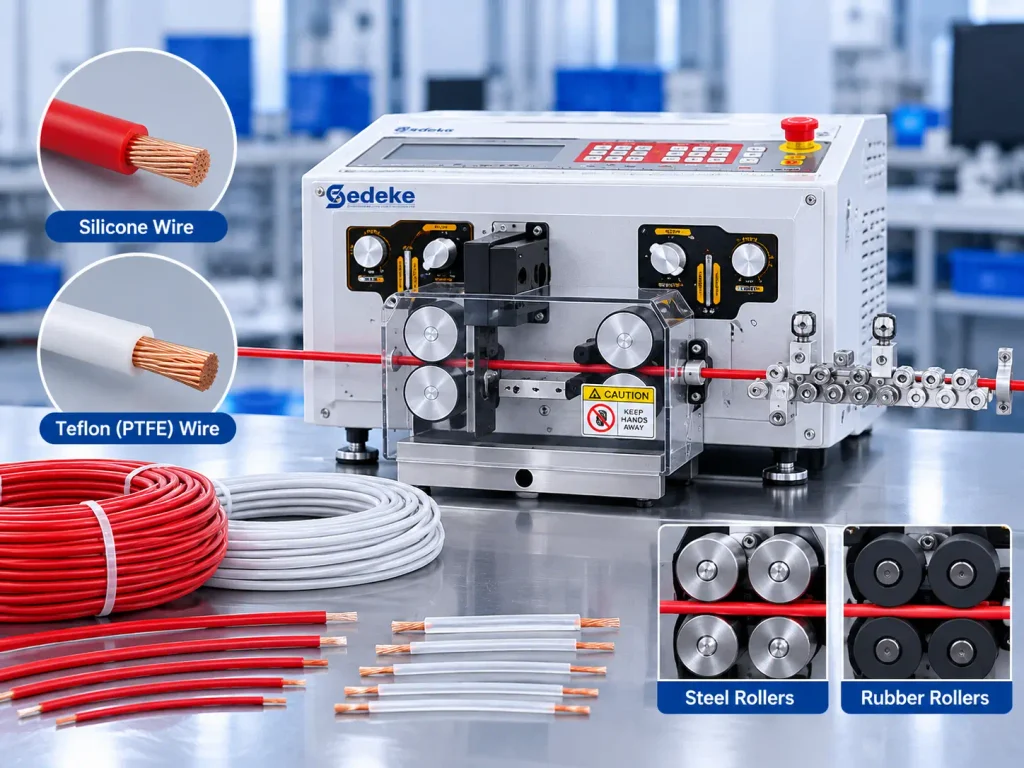
The BX4’s standard steel rollers offer a hard, wear-resistant feeding surface. Rubber rollers provide another option where surface marking or the behavior of a thin jacket makes steel rollers less suitable.
Neither option solves every feeding problem. Steel rollers can leave impressions; rubber rollers wear and can deform under prolonged pressure. Your choice should follow the wire and the finish you need.
| Your application or priority | Roller choice to discuss with Sedeke | What to watch during a trial |
|---|---|---|
| Regular wire processing with a priority on roller wear resistance | Standard steel rollers | Grip without excessive pressure or unacceptable jacket marks |
| Silicone-insulated wire | Start by assessing steel rollers; consider rubber where marking or feeding behavior calls for it | Wire straightness, buckling, surface impressions and length consistency |
| Thin, relatively hard Teflon insulation | Give rubber rollers priority in the comparison | Stable feeding without excessive compression; clean stripped ends |
| Fine, easily deflected wire | A setup selected around the actual wire, rather than pressure alone | Whether the wire stays on its feed path instead of bending or jamming |
Ask for the recommended roller configuration in your quotation so you know which setup you are ordering.
Cutting silicone wire: control the feed before increasing pressure
Silicone insulation is soft and elastic. On fine wire, that flexibility can make feeding more difficult: the wire may bend instead of advancing smoothly. Insulation thickness also changes how the wire responds to roller pressure.
If you see inconsistent lengths, simply tightening the rollers is not a reliable fix. Too little grip can allow slipping, but excessive pressure can mark the insulation and may damage the conductor.
For your BX4 application trial, focus on three checks:
- Keep the feed straight. Watch for deflection or buckling before the wire reaches the cutting area.
- Use enough grip to feed steadily. Check the jacket after processing rather than judging the setup only by whether the wire moves.
- Reduce speed if feeding becomes unstable. Establish a repeatable result before increasing production speed.
Steel rollers can still be a workable choice for silicone wire. Rubber rollers are worth comparing when surface finish is important or the wire does not feed satisfactorily with the steel setup. They should not be treated as an automatic upgrade for every silicone wire.
Once feeding is stable, assess stripping separately. The blade setting needs to release the insulation without nicking conductor strands. Changing feed pressure to compensate for an unsuitable stripping setting can create a second problem instead of solving the first.
Cutting Teflon wire: give thin insulation a gentler grip
Thin, relatively hard Teflon insulation presents a different challenge. Steel rollers can leave impressions, and excessive pressure can deform the wire. Uneven feeding can then affect cut length and make stripping less consistent.
For this type of wire, we recommend comparing a rubber-roller setup first. The aim is steady traction with less risk of pronounced roller impressions, not maximum clamping force.
Check both the outside of the wire and the stripped ends. A clean-looking jacket does not tell you whether the conductor has been nicked during stripping. If feeding jumps or the insulation does not strip cleanly, review pressure, speed and blade settings as separate variables.
If your production uses several Teflon-insulated wire specifications, include the most demanding ones in the trial. A setup selected for one insulation thickness should not simply be carried over to every wire in your order book.
When cut lengths drift, check roller condition
Rubber rollers are wearing parts. Continued compression and use can leave indentations or change their effective diameter, which can affect feeding accuracy.
If a previously stable job starts producing inconsistent lengths, inspect the roller surfaces as well as the wire path. Worn or deformed rollers may need replacement. Increasing pressure against a damaged roller can make marking worse without restoring the feed you need.
Build roller checks into your maintenance routine, especially when you process fine wire or switch frequently between materials. Before inspecting, replacing or physically adjusting rollers, stop and isolate the machine as directed in its operating manual.
What should your BX4 sample trial show?
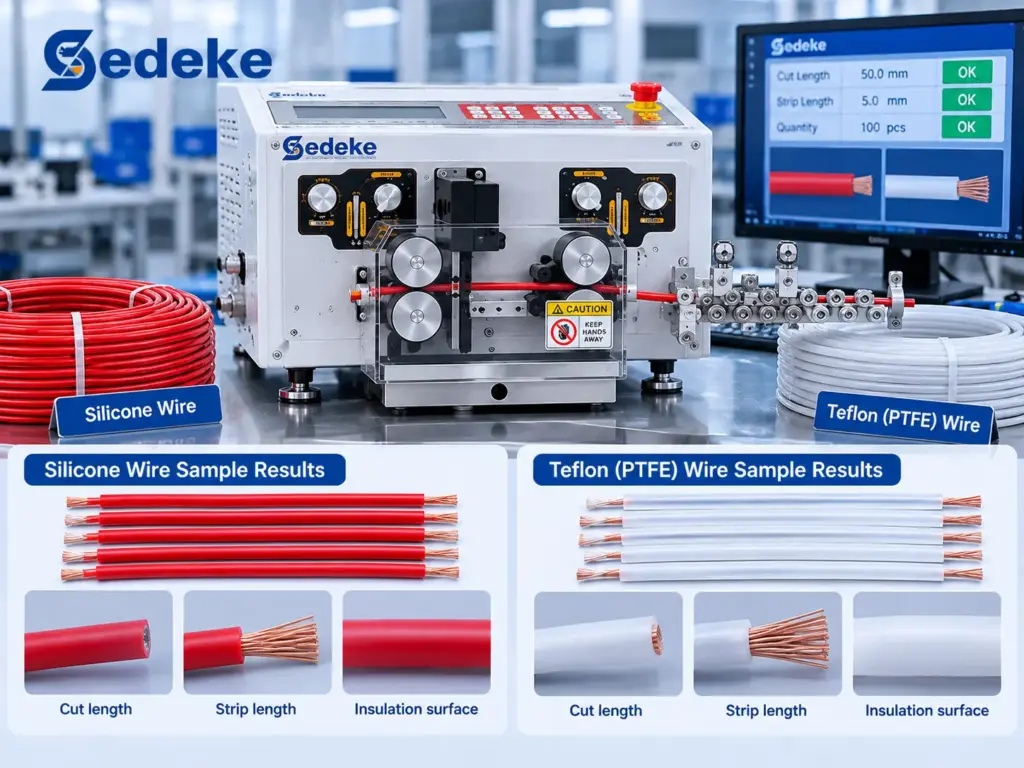
Before ordering, ask to see the results on the wire you actually use. At Sedeke, we offer sample testing and can provide test videos and result photos to help you choose your machine setup.
Use the trial to answer practical production questions:
- Does the wire feed steadily without repeated slipping, buckling or jams?
- Do measured cut lengths meet your drawing requirements across a series of pieces?
- Is the insulation free from unacceptable roller marks or deformation?
- Are stripped lengths suitable for your next operation, with no visible conductor nicks or broken strands?
- Can the selected setup run at a pace that fits your production target?
Share your acceptance criteria with us before the trial. If you use both silicone and Teflon wire, request a comparison for both rather than selecting your machine from a demonstration on standard wire alone.
For wire sizes or processing requirements outside the BX4’s scope, explore our wire cutting and stripping machine range with our team. Your material and finished-wire requirements should decide the model.
Get a BX4 quotation for your wire
Looking for an automatic wire cutter that also prepares your wire ends? Send us your wire specification, insulation material, required cut length and stripping lengths, together with your expected daily output. A photo of the wire or a sample helps us narrow down the roller setup.
We will recommend a suitable configuration and quote against your processing requirements. You can also ask us to arrange a sample trial before you decide.
Contact Sedeke for a BX4 quotation and tell us whether you are processing silicone wire, Teflon wire or both.
FAQ
Is the BX4 a cutting-only machine?
No. The ESC-BX4 is a wire cutting and stripping machine. It is intended for jobs where you need cut lengths and stripped wire ends, rather than cutting alone.
Are rubber rollers included in the standard BX4 setup?
Steel rollers are the standard setup described here. Ask us to include the roller configuration recommended for your wire in the quotation, including rubber rollers where appropriate.
Can I use one pressure setting for silicone and Teflon wire?
Do not assume the same setting will suit both. Their insulation responds differently to pressure, and wire diameter and jacket thickness also matter. Establish the setup for each production wire.
Why not run every wire at the highest speed?
Fine or flexible wire may feed less steadily as speed increases. Start with a stable cut-and-strip result, then assess the achievable production rate on your material.
What if my wire falls outside AWG 28–10?
Ask us to recommend another model from your wire dimensions and processing requirements. Include the outside diameter and insulation details as well as conductor size so we can make the selection around the complete wire.