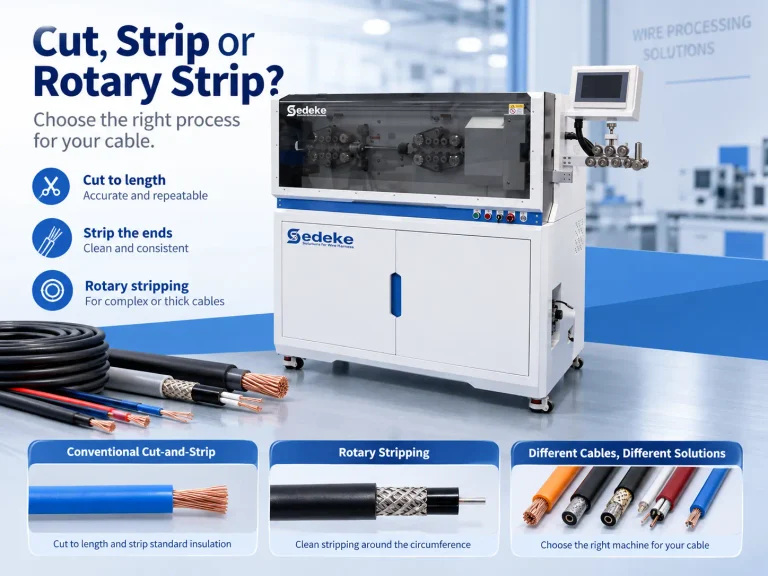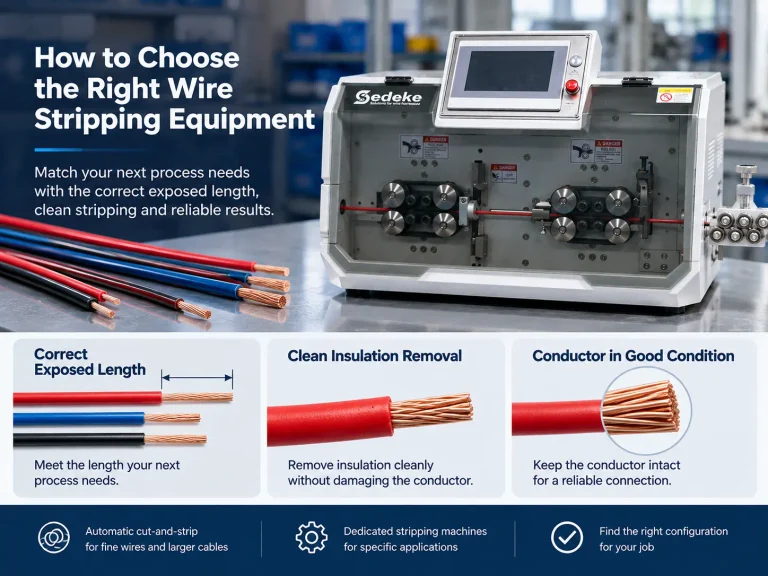


Start with conventional cut-and-strip equipment when your job is to cut wire to length and remove straightforward insulation from the ends. Consider rotary stripping when the insulation cut needs to follow the cable circumference, or when your current process leaves an unacceptable edge or damages material that must remain.
Cable diameter helps you choose a machine size. The required cut and finished cable end help you choose the stripping process. A large cable does not automatically need rotary stripping, and a fine wire does not automatically rule it out.
At Sedeke, we offer automatic cut-and-strip machines, automatic cutting systems with rotary stripping, and dedicated rotary stripping equipment. Here is how to decide which route to discuss for your cable.
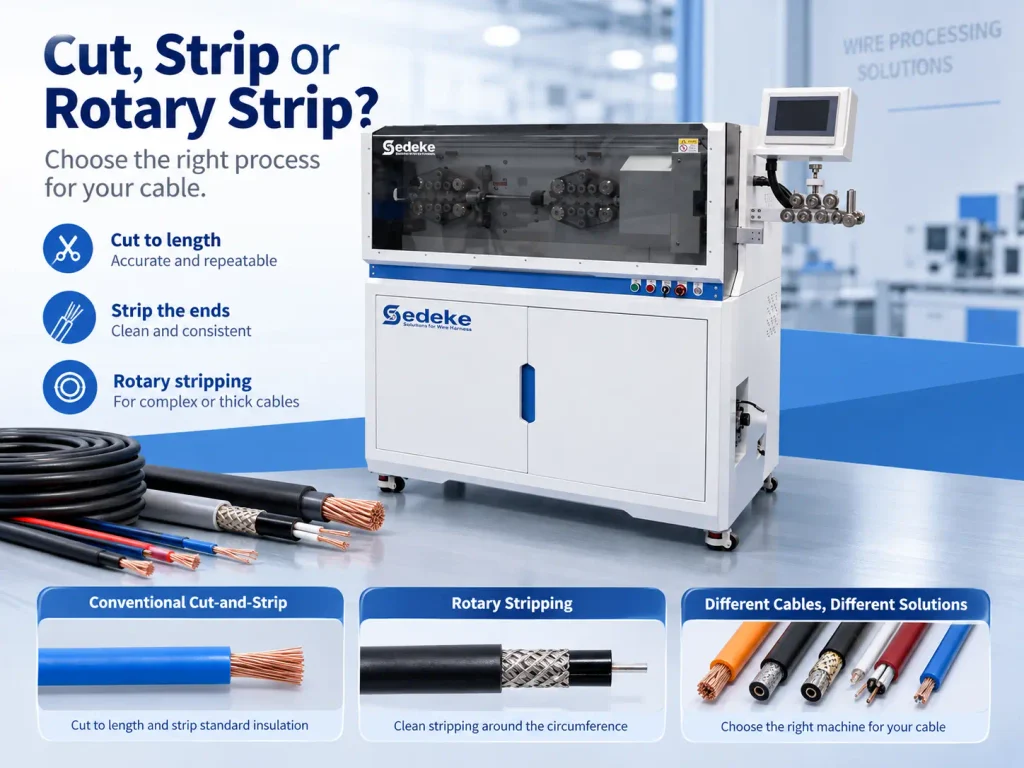
Compare the Cutting Method and the Production Flow Separately
“Rotary” describes how the stripping cut is made. “Cut-and-strip” describes a machine that cuts material to length and prepares its ends. A machine can do both.
In a conventional opposed-blade process, blades close around the wire to make the insulation cut, then the cut section is pulled away. Blade shape, wire centering and the removal movement all affect the result. V-shaped blades are one option; other geometries suit different wire constructions.
A rotary head moves its cutting edges around the cable axis to make a circumferential cut before removal. It still needs suitable gripping, depth settings and a removal sequence. Choosing a rotary head changes the cutting action; it does not remove the need to match tooling to the cable.
This leaves two separate purchasing questions:
- Which cutting method produces the required end? Compare conventional and rotary cutting on the actual insulation and retained layers.
- Which machine completes your production sequence? Decide whether you need reel-fed cutting and stripping, or stripping of cables already cut to length.
Our ESC-BXR cutting and rotary stripping series combines the two operations. It is a relevant starting point when you need rotary preparation within an automatic cut-and-strip workflow.
What Changes When You Choose Rotary Stripping?
| Selection factor | Conventional opposed-blade stripping | Rotary stripping | Your deciding check |
|---|---|---|---|
| Insulation cut | Blade geometry forms the cut as the blades close | Cutting edges travel around the cable axis | Is the cut complete and suitable for removing the required section? |
| Material beneath the cut | Protection depends on tooling, centering and setup | Protection also depends on centering and controlled depth | Inspect the conductor, shield or inner insulation you intend to retain |
| Multiple preparation steps | Capability depends on the machine and tooling | Rotary machines may support selected layer sequences | Match every required step, including any separate shield work |
| Cable size | Choose a model for the cross-section and outside diameter | Choose a model for the same physical constraints | Check actual cable dimensions rather than the technology name |
| Production flow | Available in automatic cut-and-strip systems | Available in dedicated strippers and combined cutting systems | Compare the complete job, including handling and second operations |
Compare machines that cover the same production steps. A hand-loaded end stripper and a reel-fed production machine differ in much more than blade motion.
When Conventional Cut-and-Strip Is the Right Starting Point
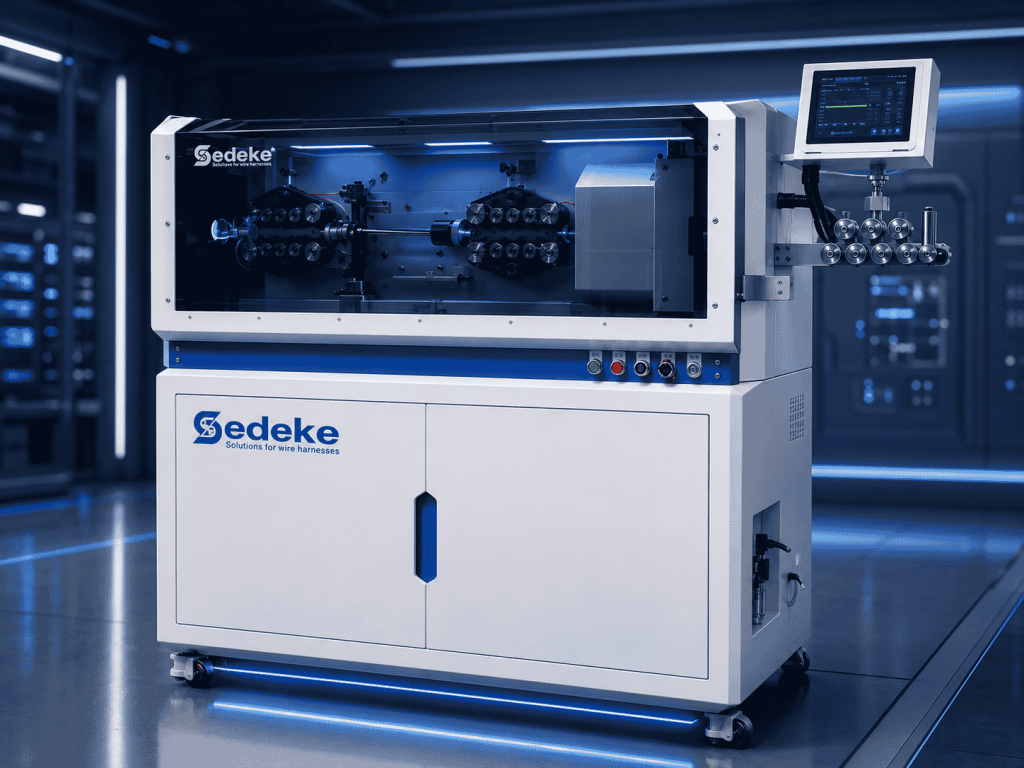
Choose conventional cut-and-strip as your first comparison for repeated cut lengths and straightforward end preparation, especially when your existing samples already meet the connection requirements. In that situation, focus the purchase on the wire range, end lengths, material feeding and the output you need.
For example, our ESC-BX30 automatic cutting and stripping machine covers a 1–30 mm² processing range and uses belt feeding. Its programmable processing parameters let you define the job around the cut and stripped ends. Special cable requirements call for sample-wire testing.
Our ESC-BX120 automatic cutting and stripping machine has a specified processing range of 1–120 mm². When a cable exceeds a smaller machine’s range, compare suitable larger models before deciding whether the stripping method also needs to change.
If the current problem is wire slip or length variation, inspect feeding and positioning before treating rotary cutting as the solution. A different stripping head will not, by itself, settle how the cable is delivered and held.
When to Put Rotary Stripping on the Shortlist
Prioritize a rotary trial when the cut itself is the problem: the edge tears, part of the insulation remains connected, or the required layer needs a controlled circumferential separation. Keep a failed sample so the comparison addresses the defect you need to remove.
For elastic or difficult insulation, compare the finished cut. Material names such as silicone or polyurethane help describe the job, but the formulation, wall thickness and cable construction still matter. Compare complete removal, edge condition and damage to the retained material. This gives you a useful decision even when two cables share the same insulation label.
For layered cable, start with a drawing of the finished end. Identify which jacket section is removed, which shield section remains, and where the dielectric or inner insulation ends. Jacket stripping, braid preparation and inner-conductor stripping are separate requirements. Specify whether the proposed machine completes them or leaves work for another station.
For cables already cut to length, compare a dedicated stripping station. Our CS series rotary cable stripping machines use double rotating blades. The CS-100 has a stripping-diameter range of 5–25 mm and a stripping-length range of 0–100 mm; the CS-300 covers 12–50 mm and 0–300 mm respectively. These ranges help you identify a candidate for end preparation without assuming you need a new reel-fed cutting line.
Rotary stripping also exists for fine wire. For example, the Schleuniger RotaryStrip 2400 data sheet lists a conductor range beginning at 0.013 mm². The useful selection rule is the cutting task and the model’s working range, rather than “small wire means conventional, large cable means rotary.”
Three Jobs That Lead to Different Choices
A straightforward power wire needs repeatable cut lengths and stripped ends. Start with an automatic cut-and-strip configuration sized for the wire. Compare rotary only if the sample result identifies a cutting problem that warrants it. Larger conductor size alone does not establish that need.
A cable arrives at the station already cut, and only its jacket ends need preparation. Start with a dedicated stripping machine. Check the outside diameter, strip length, loading method and condition of the layers beneath the jacket. Compare that workflow with adding another combined cutting machine.
A shielded signal cable needs several stepped preparation lengths. Start with the finished-end geometry and the required shield treatment. Select a machine configured for those steps. A rotary jacket stripper and a machine that prepares a complete coaxial end are different purchasing options, even though both may use rotating blades.
Use the sample comparison to check the configuration against the required cable end.
Compare Useful Output, Not Just Cycle Speed
A quoted stripping cycle may cover only one end or one operation. Your production requirement may include cutting, both ends, several layers, loading and unloading.
Ask each proposal to cover the same finished part. During the trial, record:
- The complete preparation sequence: cut length, both ends and every layer or shield operation included.
- The finished result: dimensions, removal quality and condition of the conductor and retained layers.
- Elapsed time for the same batch: include the handling and secondary steps required by the proposed workflow.
- Accepted output and rework: keep rejected pieces separate and record why they failed.
Calculate accepted parts per hour as accepted parts divided by the elapsed trial time in hours. For mixed production, compare changeover time separately as well. This connects speed to the parts your next operation can actually use.
For quotations, request the tooling, guides, feeding equipment and additional stations needed for that same job. A lower-priced machine with an unfinished preparation step is a different proposal from a system that completes it.
FAQ
Is rotary stripping always more accurate?
No. Compare accuracy for the specific feature you need: strip length, cutting depth or overall wire length. Then inspect the prepared cable. A precise length result can still have an unacceptable insulation edge or damaged retained layer. Use the finished-end requirements to compare the proposed configurations.
Does a rotary machine automatically remove braided shielding?
No. Cutting an outer jacket and preparing a braid are different operations. State whether the braid must remain intact, be shortened, folded back or removed. The proposed tooling and sequence must cover that requirement; the word “rotary” alone does not describe the shield-processing function.
How do I choose between full and partial stripping?
Choose according to the next assembly step. Full stripping removes the cut insulation section. Partial stripping leaves a sleeve in a specified position. Give the supplier both the intended strip geometry and retained-sleeve position so the proposed machine is checked for the required removal movement.
Can I change an existing machine to rotary stripping by replacing the blades?
Treat that as a machine-compatibility question. A rotary process needs a suitable head, drive, controls and cable support. Ask the machine manufacturer about an approved conversion for the exact model and configuration. Do not assume that changing a blade shape provides a rotary mechanism.
What should I send to get a machine recommendation?
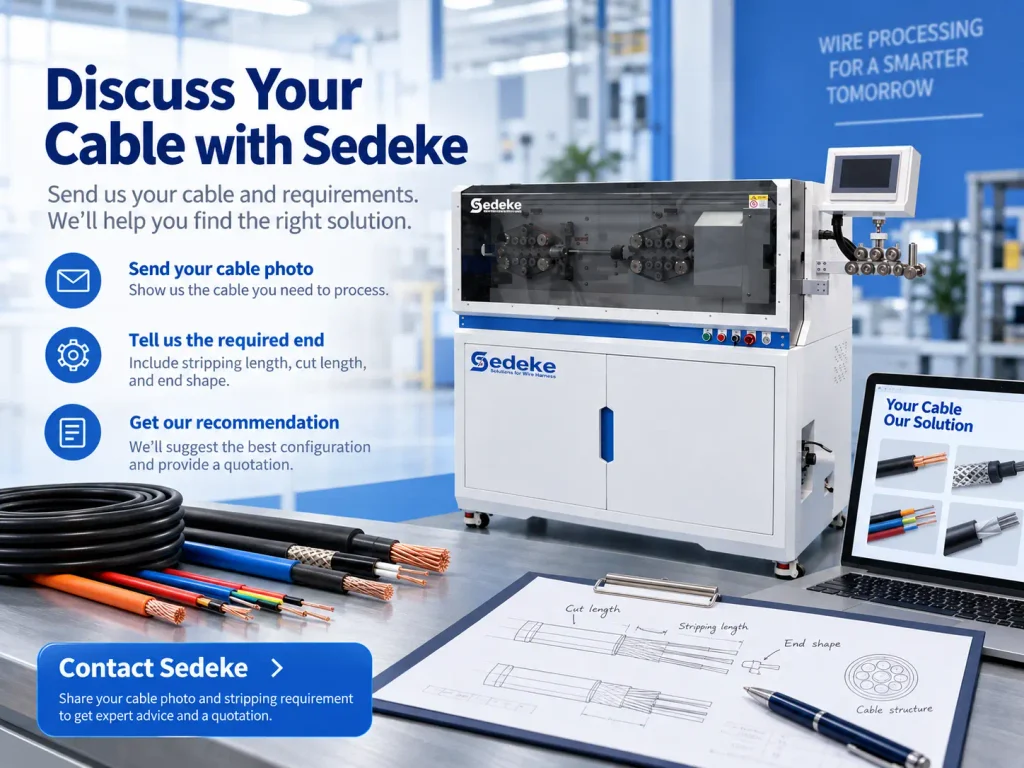
Start with a cable photo, its outside diameter and a sketch of the stripped end. Tell us whether you need automatic cutting or only end stripping. If a current process is failing, include a photo of the defect. We can then discuss the relevant equipment route and the sample details needed next.
Discuss Your Cable with Sedeke
Send us the cable you need to process and the end you want to produce. We can help you compare an automatic cut-and-strip configuration, a combined rotary system or a dedicated stripping station.
Contact Sedeke with your cable photo and stripping requirement. Include your target output when you are ready to discuss sample processing, a suitable configuration and a current quotation.