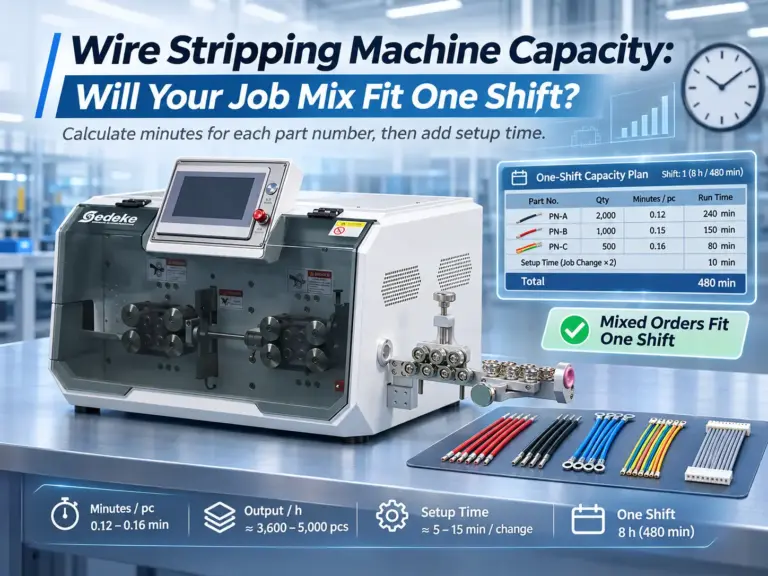


Suppose your customer orders 3,300 wire leads for the end of the shift, then switches 300 of them from a short lead to a longer one. In the example below, that change turns 15 minutes of spare time into 15 minutes of overtime on the same machine.
To size a wire stripping machine for mixed orders, calculate minutes for each part number, then add setup time. Divide the quantity due by the number of good leads you can produce per hour on that job. Multiply by 60 to get minutes. If the order runs over, the shortfall tells you how many minutes to recover and which part to put on the supplier’s machine for a timed run.
Count the lead your assembly team can use
Start with the finished lead on the drawing. If assembly needs a wire cut to length and stripped at both ends, count one accepted wire when both ends are ready. A bench stripper processing one end per insertion will cycle twice for that job. A cut-and-strip machine can deliver both ends in one pass. Ask both suppliers for finished leads per hour from the same incoming material. If both start with a reel, include the time to cut, transfer and turn each lead on the bench route. If you buy wire already cut to length, start the clock with those pieces at the bench.
Give each timed run its own part number, cut length and strip length for each end. Cut length alone can make a substantial difference. For its Model 7400, Eubanks lists estimated outputs of 3,400 pieces per hour at 0.5 m and 2,700 at 1 m. Doubling the length adds feed time while a cut and two end strips still take place on each lead. Eubanks Model 7400 production rates
Turn a sample run into minutes per order
After first-piece approval, start the clock with the next lead. Count the leads that pass on the first attempt, including the time the operator spends collecting them. A lead waiting for rework stays out of the count. Record setup and first-piece approval in a separate time entry. Log occasional stops such as a reel change separately. Subtract those minutes from the sample interval, then budget the expected number of reel changes across the actual shift.
Accepted leads per run hour = first-pass good leads × 60 ÷ timed run minutes after separately logged stops.
Here is an illustrative order on one machine with one operator. The shift has 480 minutes available after breaks. Setup and first-piece approval for the two jobs take 45 minutes in total. The two sample runs include normal collection. Assume no other downtime or rework during this shift.
| Part | Finished lead | Good leads in a 20-minute run | Accepted leads per run hour |
|---|---|---|---|
| A | Short lead, same strip length at both ends | 200 | 600 |
| B | Longer lead, different strip length at each end | 100 | 300 |
For a running order, use representative batches of your own parts. A short trial gives you a running rate. A shift record also captures the reel changes, quality checks and interruptions that happen less often. When those minutes fall outside your timed batch, add them to the schedule.
Two 3,300-piece orders, two different finish times
The first order calls for 2,400 A leads and 900 B leads. At 600 accepted leads per hour, A needs four hours. B needs another three. With 45 minutes for setup and approval, the order takes 465 minutes.
| Job mix | A run time | B run time | Setup and approval | Total against 480 minutes |
|---|---|---|---|---|
| 2,400 A + 900 B | 240 min | 180 min | 45 min | 465 min, 15 min spare |
| 2,100 A + 1,200 B | 210 min | 240 min | 45 min | 495 min, 15 min short |
The change frees 30 minutes on A and adds 60 on B. That half hour moves the finish past the end of the shift. If you average 600 and 300 to get 450 leads per hour, both orders appear to take 485 minutes including setup. You would turn down the first order even though it fits.
You can repeat the calculation in an ordinary order sheet. Give each part number columns for quantity due, accepted leads per run hour and run minutes. Calculate the last column as quantity due × 60 ÷ accepted leads per run hour. Add the run minutes down the sheet, then add the time for the setups and other stops on that shift.
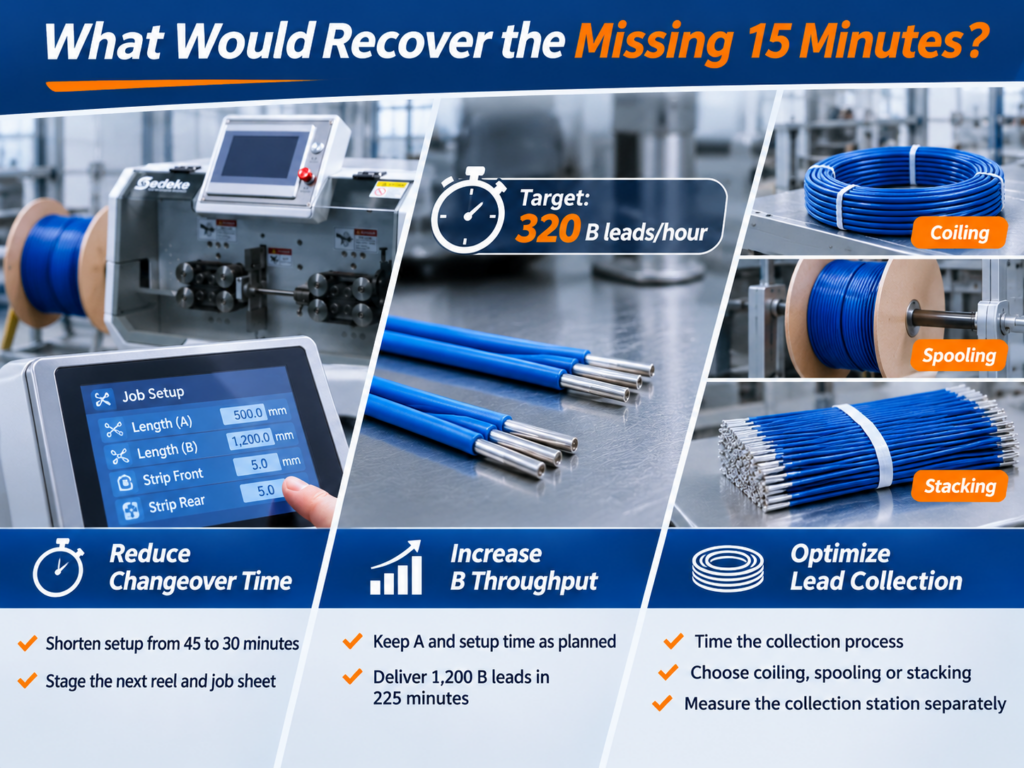
What would recover the missing 15 minutes?
If the time is in changeover, the second order leaves 30 minutes for setup and first-piece approval. Bring the total down from 45 to 30 and the order fits exactly. Stage the next reel and job sheet while the current batch runs, where staffing permits. Keep first-piece inspection in the schedule. With zero minutes to spare, a late reel change still pushes delivery into overtime.
If B takes too long, keep A and setup at their original times. B then has 480 − 210 − 45 = 225 minutes. To deliver 1,200 B leads in that window, the target is 320 accepted B leads per run hour. Give each supplier the same line on your request for quotation.
Deliver 1,200 finished B leads in 225 running minutes, with both ends prepared to drawing and one operator collecting the batch.
If finished leads pile up at the outlet, time a batch through collection. For a long cable going straight to crimping, a supported tray can leave both ends accessible. For a cable shipped as a coil, include coiling and removal in the timed handoff. If a second operator handles collection concurrently, measure that station separately. Its ability to clear the batch can set the pace for the line. Compare coiling, spooling and stacking for long cables
Where the Sedeke ESC-BX30 fits
For repeat orders that start on a reel and go to assembly as cut leads with both ends stripped, we recommend our ESC-BX30 automatic cutting and stripping machine. Its belts feed the cable to the programmed cut length. You set the front and rear strip lengths separately, so a lead like B can leave the machine ready for collection without a second operator stripping the opposite end.
Put the part that consumes the most minutes at the top of your enquiry. In the second order, B accounts for only 1,200 of the 3,300 leads, yet it occupies the machine longer than A. A quote built around B’s cut length, end dimensions and collection method addresses the job that decides your finish time.
Frequently asked questions
Can I use a catalogue rate for a first estimate?
Yes. Divide the quantity due by the published hourly rate to get an estimate of running hours when the listed cable and end preparation match your job. For a delivery commitment, use the rate from your own part and add the shift time spent outside that run.
How do I count pieces on a machine that feeds two wires at once?
Count each lead that meets the drawing. If two leads emerge from a cycle and only one passes, enter one accepted lead. A timed count lets you compare a dual-feed arrangement and a single-feed machine in the same unit.
Should I deduct scrap again if I timed only good leads?
When you count good leads over the entire run, including the time spent making rejects, the measured rate already includes that loss. If the shift also includes a later rework batch, give it its own time entry and count each recovered lead once at release.
How many machines do I need for the shift?
For machines that can each run the entire mix, divide the workload for the shift by the minutes available per machine and round up as a first estimate. Then assign the actual batches, setup time and operators to each machine. In this example, recovering 15 minutes on one machine is the first option to price.
What is a 15-minute saving worth?
If that shortfall costs you 15 minutes of paid overtime every shift, multiply 0.25 hours by the overtime cost for the crew and the number of affected shifts. Compare that recurring expense with the cost of a setup or equipment change. If the crew finishes within paid hours anyway, the benefit is room for more orders.
Get a Sedeke quote for your job mix
Send us two lines from your production schedule. Pick a typical lead and the part that uses the most machine minutes across the shift. Include the wire type, cut length, strip length at each end and quantity due per shift. A marked-up drawing will do. We can use those jobs to recommend a cutting and stripping configuration and quote the equipment for your application. Request a wire processing machine quote from Sedeke