

Cutting and stripping do not finish the handling problem. Once a long cable leaves the machine, you still need to keep it off the floor, protect the prepared ends and move it to the next operation without creating tangles or extra labor.
The right receiving method depends on the output you need. You may keep each length straight, form it into a loose coil or wind it onto a spool. Each option changes the space, equipment, operator work and packaging around your wire cutting and stripping process.
There is no universal cable length at which one method becomes mandatory. Start with the next operation and the accepted finished format, then work backward to the equipment.
Start with the required output, not the equipment name
Machine names are not always consistent between suppliers. Your output specification is a safer starting point.
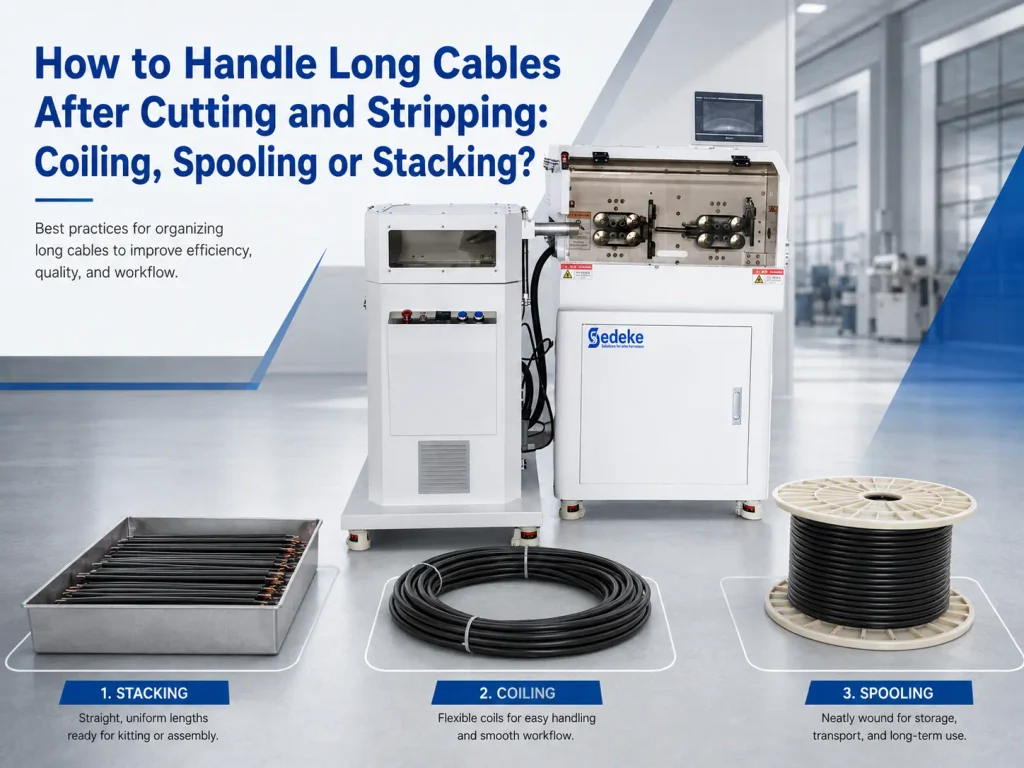
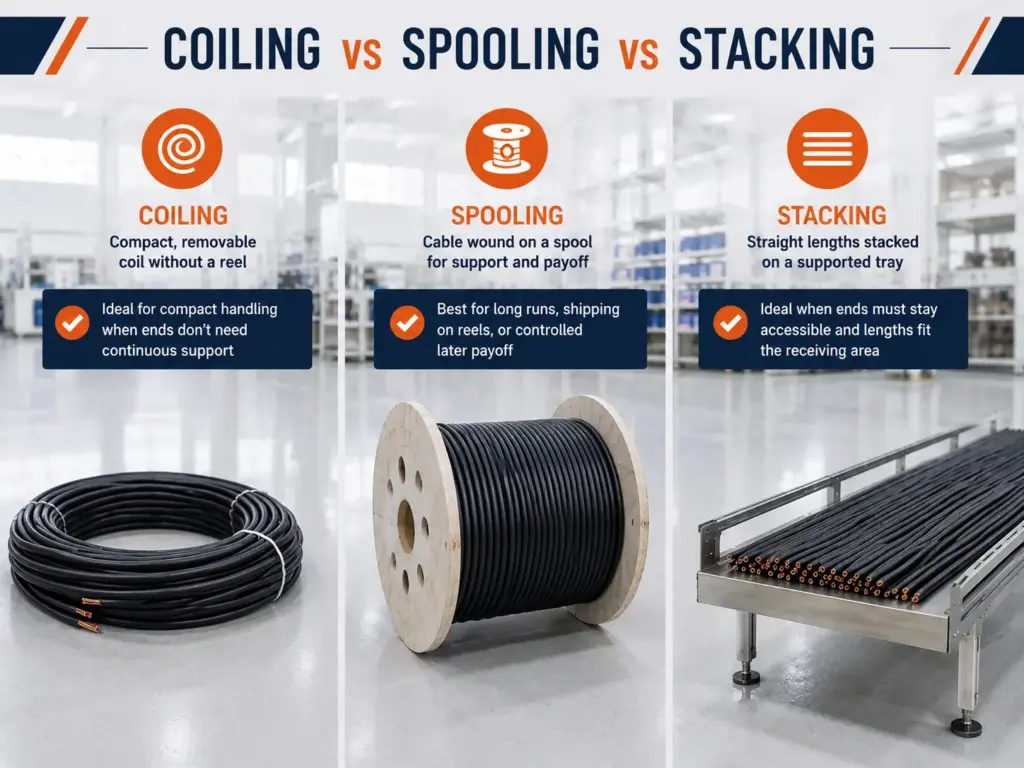
In this article, stacking means receiving cut lengths in a straight or gently supported arrangement on a tray, table, belt or synchronized discharge area. Coiling means forming one finished length into a controlled loose ring that you can remove without a supporting reel. Spooling means winding the cable onto a reel or spool that stays with it during storage, transport or later payoff.
You may also see winding and coiling used almost interchangeably. In Sedeke’s current product range, winding usually describes the machine process, while coiling describes the finished loose form. This is different from winding electromagnetic coils for motors, transformers or bobbins.
Rewinding is outside this three-way output comparison. It normally describes transferring material from one reel or drum to another receiver. That may be an important production task, but it is not a finished-output format parallel to stacking.
When stacking is the simplest route
Stacking can work well when the next operation needs direct access to one or both cable ends. If you plan to crimp terminals, add seals, inspect strip quality or load pieces into an assembly fixture soon after cutting, keeping the cable straight can avoid an extra uncoiling step.
The receiving area must still fit the job. A length that rests neatly on a supported tray can become difficult to control when it extends past the available surface. Pieces may cross, ends may fall, or cable may drag as the batch grows. These are layout and material issues, so a fixed maximum stacking length would be misleading.
Before you choose this route, check:
- the longest finished length, not only the average;
- the usable receiving length and width;
- whether cable stiffness helps it stay organized or causes it to spring away;
- how the stripped ends will be separated and protected;
- how many pieces may accumulate before an operator removes them;
- whether different lengths will be mixed in the same batch.
Stacking usually needs the least complicated hardware, but that does not make it the lowest-labor solution. If an operator repeatedly clears, sorts and untangles long pieces, you have only moved the work downstream.
When coiling is the better route
Coiling gives you a compact output without leaving the cable on a reel. It is worth considering when a long, flexible cable would consume too much receiving space as a straight length, or when you need to lift, store, kit or transport individual lengths after processing.
The coil itself must be specified. At minimum, define the inner diameter, acceptable outer diameter or width, finished weight and the way the coil will be secured. You should also decide where the cable ends should remain, because hidden or crossed ends can slow the next operation.
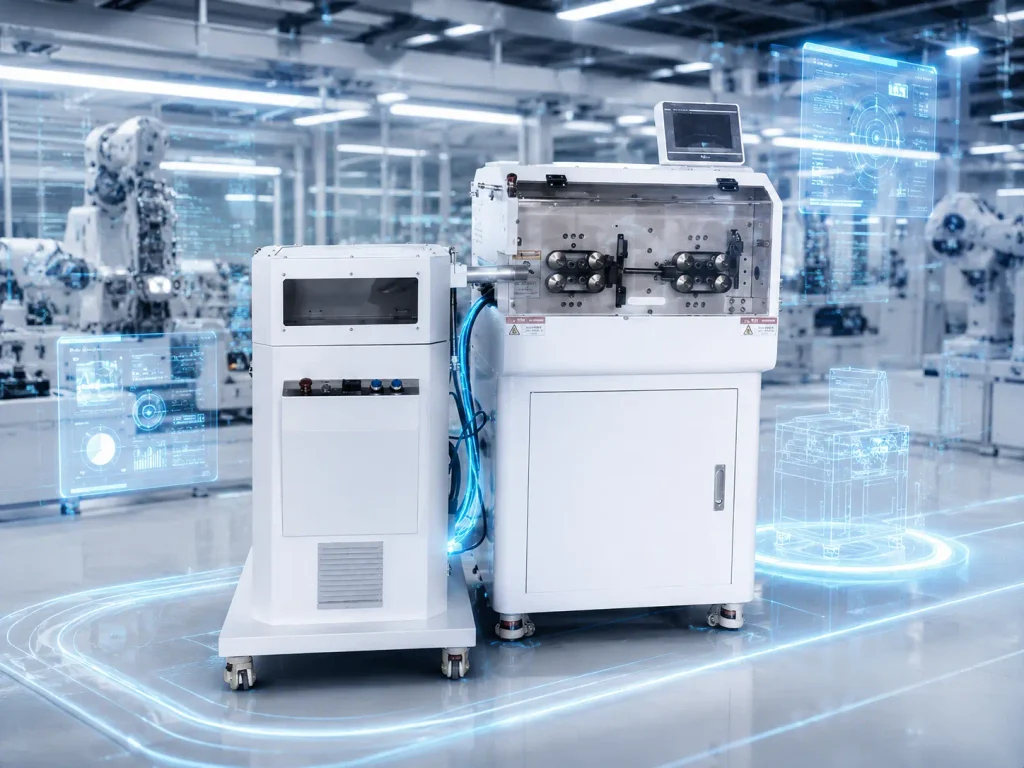
Sedeke’s CC-380 cable coiling machine is a verified example of this post-cut route. Its current product page describes use with a cable cutting and stripping machine so that processed cable can leave the station in a coiled form for handling, storage or transport.
Do not choose coil diameter from package size alone. The cable construction and permitted bend also matter. A flexible single-core wire, a multi-core sheathed cable and a shielded cable may behave differently at the same outside diameter. If the bend limit is important, use the cable manufacturer’s requirement or your approved process specification rather than a generic rule.
You also need a removal plan. A stable coil at the machine is not accepted output if it collapses when lifted. Depending on the job, you may need a manual tie, automatic binding, a reusable strap or a tray that supports the coil. Sedeke’s current wire winding machine range includes benchtop and floor-type coil-forming routes, with binding or tying available on selected configurations. The correct route still has to be matched to your cable and finished coil.
When spooling is worth the added hardware
Spooling keeps the cable supported on a reel. It can make sense when the cable will be paid off later, when a shipping specification requires a reel, or when a loose coil would not hold the required form during storage and transport.
This output adds decisions that loose coiling does not. You must define the spool flange diameter, barrel diameter, usable width, bore or mounting method and maximum loaded weight. The winding path may also need traverse control so the cable is distributed across the spool instead of building up in one position.
Tension needs particular care. Too little control can produce loose or uneven layers. Excessive tension may stretch the cable, change its shape or load a prepared end. The acceptable setting depends on the cable, so it should be proven with your actual material and acceptance criteria.
A spool also becomes part of your material flow. Ask who supplies it, whether it is disposable or returned, how it is loaded and unloaded, and how the next station pays the cable off. A technically good spool can still be a poor choice if empty-reel handling, storage or return logistics add more work than the cable requires.
Sedeke’s verified sources reviewed for this article cover loose coiling and winding routes. They do not confirm a dedicated Sedeke spooler, so spooling is presented here as a neutral alternative rather than a Sedeke product claim.
Coiling vs spooling vs stacking
| Output method | Often fits when | Information you must define | Main tradeoff | Typical operator task |
|---|---|---|---|---|
| Stacking | Ends must stay accessible and the receiving area can support the finished length | Maximum length, receiving space, batch quantity, end separation | Uses more linear space as lengths grow | Clear and transfer straight pieces |
| Coiling | You need a compact, removable output without a retained reel | Coil inner diameter, outer size or width, weight, bend limit, securing method | Adds a coil-forming and removal step | Remove, secure, label or transfer the coil |
| Spooling | The cable needs continuous support, shipping on a reel or controlled later payoff | Spool geometry, loaded weight, traverse, tension, payoff method | Adds spool inventory and reel handling | Load, unload and manage full and empty spools |
The table is a screening tool, not a machine specification. Two jobs with the same cut length may need different outputs because one moves directly to terminal processing while the other ships to a remote assembly site.
Check cable and process variables before you choose
Cable construction and bend requirement
Record the conductor size, cable outside diameter, number of cores, insulation or jacket material, shielding and stiffness. Add the permitted bend from an approved source when it applies. Do not assume that outside diameter alone predicts coiling behavior.
Finished cut and strip dimensions
Give the full length range, front and rear strip dimensions, and whether either end is fully or partially stripped. Long exposed conductors or delicate prepared ends may need a different discharge path or protection method.
Output geometry and weight
For a coil, specify the inner diameter, maximum outer size, width and finished weight. For a spool, provide a drawing or all relevant reel dimensions. For a stack, show the usable receiving space and the maximum accumulation quantity.
Batch mix and changeover
High product mix can change the best answer. A route that performs well on one repeated cable may create too much setup if coil dimensions, spools or discharge positions change throughout the shift. List the real product mix and expected batch sizes.
Upstream interface
The receiving system has to accept cable at the timing and speed of the cutting and stripping machine. Confirm the upstream model, discharge height, signal interface and whether the cable arrives continuously or as separate completed pieces. A fast coiler does not help if transfer timing creates stoppages between the two machines.
Coil fixing, labeling and traceability
Decide whether the output needs a tie, binding band, label or batch separation. Include label position and end identification if the next operation depends on them. These details affect both equipment scope and operator work.
Removal and acceptance
Describe how the operator or material-handling device will remove the output. Then define what a good result looks like: no tangles, no unacceptable crossovers, protected stripped ends, correct coil or spool dimensions, readable identification and a stable format after removal.
Match the output method to the next operation
If terminal processing or assembly happens immediately, stacking may preserve the fastest access to the cable ends. It also lets an operator notice strip or cut problems before the cable is packed into another form. The decision changes if straight pieces exceed the available receiving area or become difficult to separate.
If the cable will be stored, kitted or transferred between departments, a loose coil can reduce the footprint and make individual lengths easier to carry. A tie or binding step may be useful when the coil must hold its shape in a bin or during internal transport.
If the finished cable ships on a reel or must pay off into another continuous process, spooling may be the better format. In that case, reel compatibility and later payoff are part of the original equipment decision, not packaging details to solve after the line is installed.
Compare accepted output, not machine speed alone
A quoted winding or discharge speed does not show how many usable pieces reach the next operation. Your comparison should include setup, clearing, coil or spool removal, tying, labeling, changeover and any time spent correcting tangles or damaged ends.
A practical measure is accepted outputs delivered to the next step per staffed hour. Define the accepted result first, run your actual cable, and record every manual task needed to reach that result. This exposes a common tradeoff: a method may have more hardware but less downstream sorting, or simpler hardware but more operator handling.
Also test the boundaries of the application, not only the easiest sample. Include the longest length, the heaviest finished output, the stiffest cable, the most delicate stripped end and a representative changeover. That gives you evidence for the real production mix.
What to send Sedeke for a coiling review and quotation
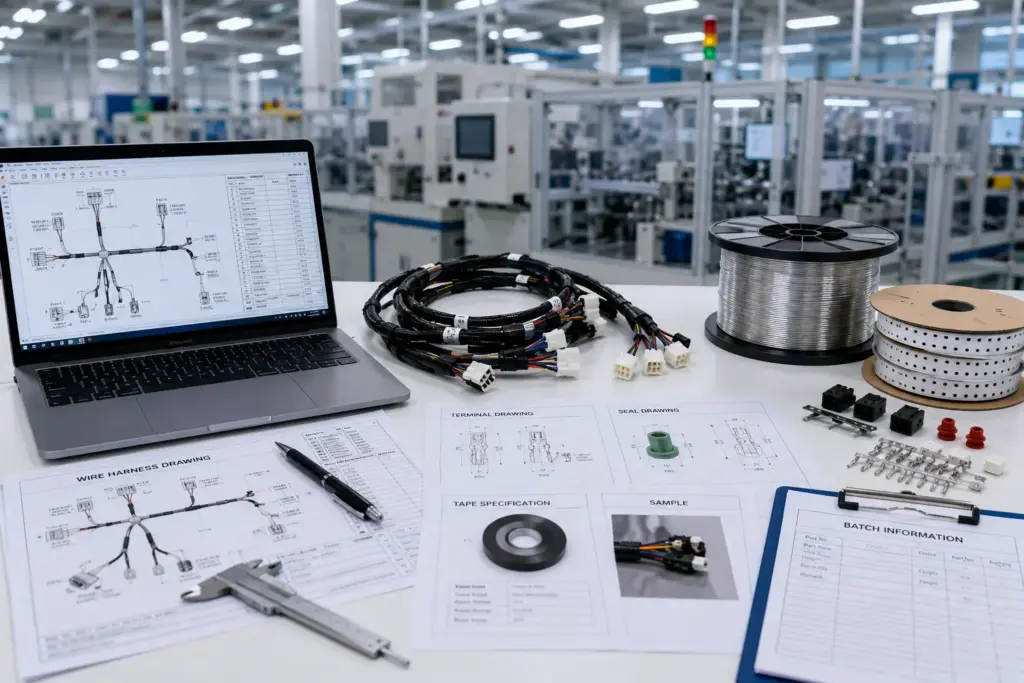
If a controlled loose coil is the output you need, send Sedeke a complete application package so the discussion can move directly to configuration and current pricing. Include:
- actual cable samples and a cable construction drawing, if available;
- conductor size, outside diameter, core count, insulation or jacket material and shielding;
- minimum, normal and maximum cut lengths;
- front and rear strip requirements;
- target coil inner diameter, maximum outer size or width and maximum finished weight;
- required end position and permitted bend requirement;
- batch sizes, product mix and target accepted output;
- the upstream cutting and stripping machine model, discharge height and interface information;
- whether the finished coil needs tying, binding, labeling or other packaging;
- photos or a short video of the current handling problem and available floor space;
- your destination, required delivery window and any site-specific electrical or safety requirements.
With those inputs, you can ask Sedeke to review the coiling application, identify a suitable current configuration, arrange sample evaluation where applicable and provide a quotation based on the confirmed scope. Use the Sedeke inquiry page to submit the requirement rather than requesting a machine from cable length alone.
FAQ
Is cable coiling the same as wire winding?
They can describe the same coil-forming task. In Sedeke’s current range, winding usually refers to the machine process and coiling to the finished loose cable form. Always confirm the required output instead of relying on the label.
Is spooling the same as rewinding?
No. Spooling describes putting cable onto a spool as the required output. Rewinding describes transferring material from one reel, drum or winding to another receiver. A rewinding system may create a spooled output, but the terms do not define the same production task.
Which method is best for very long cables?
There is no universal answer. Compare the cable’s bend requirement, finished weight, available receiving space, next operation and packaging format. Long flexible lengths may benefit from coiling, while a later controlled payoff may justify a spool.
Can a coiler work with a cutting and stripping machine?
Yes, if the machines and material flow are compatible. Sedeke’s current CC-380 page specifically describes use with a cable cutting and stripping machine. You still need to confirm cable behavior, discharge timing, coil specification, interface and operator removal.
What information is needed for a coiling quotation?
Provide the cable construction and samples, cut and strip dimensions, target coil geometry and weight, batch mix, accepted output, upstream machine details, binding or labeling needs, destination and delivery requirement. This gives the supplier enough context to review the application rather than quote from one diameter or length.
Final thoughts
Choose the output before you choose the peripheral equipment. Stacking keeps ends accessible, coiling creates a compact loose format, and spooling keeps the cable supported for storage, shipping or later payoff. The best option is the one that delivers accepted cable to your next operation with manageable space, labor and risk.
When coiling matches that requirement, document the cable and finished-coil specification and ask Sedeke for an application review and current quotation. That is more reliable than selecting a model from a general machine name or an arbitrary length threshold.