

Introduction
Overseas factories and agents often face a critical dilemma when sourcing industrial equipment from Chinese suppliers: the promise of global reach versus the reality of localized support. In the highly competitive landscape of automotive, aerospace, and consumer electronics manufacturing, balancing capital expenditure (CapEx) with operational reliability is a constant challenge. While the cost-effectiveness and rapid technological innovation of Asian manufacturers are undeniably attractive, the potential for significant downtime and operational bottlenecks due to cross-timezone communication and remote-only assistance can quickly erode any initial financial savings. Many existing supplier evaluation guides focus heavily on upfront metrics.
Procurement teams are frequently trained to scrutinize ISO certifications, factory floor manufacturing capabilities, or bottom-line pricing. Yet, they frequently overlook a crucial element for international buyers: a robust, regionalized support infrastructure. When a high-speed production line halts, the price you paid for the machine matters far less than how fast you can get it running again. This comprehensive guide aims to fill that critical gap in the procurement process. We will explore exactly why local support is paramount for seamless, continuous wire processing operations.
Furthermore, we will detail what specific criteria procurement managers, supply chain directors, and factory engineers in Europe and Southeast Asia should consider when vetting potential partners. Finally, we will outline how to identify a wire harness machine supplier that is truly equipped to support your global, multi-region needs into 2026 and beyond. Understanding these operational nuances can significantly shorten equipment introduction cycles, improve overall equipment effectiveness (OEE), and minimize costly production stoppages.
This article is part of our Wire Harness Equipment Guide series. For machine type selection, see: Wire Stripping Machine Guide
The Hidden Cost of Timezone-Only Support for Wire Processing Equipment
When evaluating a wire harness machine supplier, the initial quotation only tells a fraction of the story. The Total Cost of Ownership (TCO) is heavily influenced by what happens after the equipment is installed on your factory floor. Relying on a manufacturer that only provides support from their headquarters in China introduces invisible, yet highly impactful, financial risks to your operations.
Production Downtime and Delays
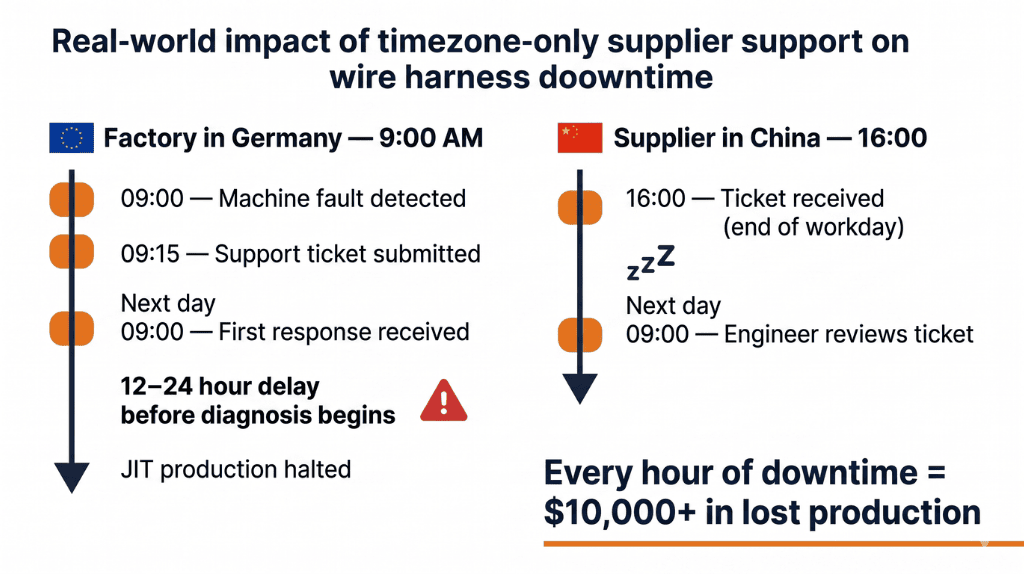
In modern manufacturing, Just-In-Time (JIT) production schedules leave very little room for error. When a wire stripping machine malfunctions at a factory in Germany at 9 AM local time, and the only available support is 7,000 kilometers away in China, the production line simply cannot afford to wait. Every single hour of delayed troubleshooting translates directly into lost output. In the automotive sector, for instance, a delayed wire harness can halt the assembly of an entire vehicle, leading to missed delivery deadlines and triggering cascading disruptions across the entire downstream supply chain. For high-volume wire harness manufacturing operations, even a few hours of unplanned downtime can cost tens of thousands of dollars in lost productivity and SLA penalties from clients. When your primary wire stripping machine manufacturer lacks a local footprint, you are forced to wait for the Earth to rotate before you can even begin to diagnose a critical system failure. This geographical reality transforms minor technical hiccups into full-scale production crises.
Escalating Maintenance and Repair Costs
Remote diagnostics sound highly efficient in theory, but in the physical realm of wire processing equipment, they often fall short. Troubleshooting complex mechatronic systems remotely requires multiple rounds of asynchronous communication. A typical scenario involves a local operator describing symptoms via email, waiting for a response, attempting a fix, conducting a video call with a remote engineer, and waiting again for further instructions.
When remote diagnosis fails to pinpoint the exact issue, the financial burden escalates rapidly. Emergency air freight of spare parts from China becomes necessary to bypass standard shipping times. The logistics costs associated with next-day international air freight for heavy industrial components—such as servo motors, specialized crimping applicators, or heavy-duty feeding mechanisms—can easily exceed the actual value of the parts themselves. Furthermore, your internal maintenance team spends countless hours on protracted support calls and trial-and-error repairs instead of focusing on productive, preventative maintenance work.
Communication Barriers and Frustration
Time zone differences between China (UTC+8) and major manufacturing hubs in Europe (UTC+1/UTC+2) or Southeast Asia (UTC+7) create inherent friction in B2B technical support. Critical issues reported at the end of your European workday will likely not receive acknowledgment until the following morning, inherently adding a 12-to-24-hour delay to any resolution timeline.
Beyond the clock, communication barriers play a significant role in escalating frustration. Industrial machinery involves highly specific terminology. Language nuances in technical documentation, combined with cultural communication differences, often lead to misunderstandings. A local operator might describe a "feed roller slippage," while the remote engineer translates this as a "motor torque failure." These misalignments compound problems rather than resolve them, leading to the ordering of incorrect spare parts and further extending equipment downtime.
Diminished Equipment Value and Lifecycle
Any wire harness equipment for sale represents a significant capital investment for your facility. These machines are engineered to operate within incredibly tight tolerances to ensure the electrical integrity of the harnesses they produce. Without timely, hands-on maintenance support, minor mechanical wear and tear quickly escalates into major, catastrophic repairs. Machines running slightly out of specification due to delayed calibration adjustments suffer from compounding issues. They consume more energy, produce inconsistent output that fails quality control checks, and experience accelerated mechanical wear.
A high-quality wire processing machine should have an expected operational life of 10 to 15 years. However, under suboptimal, remote-only support conditions where preventative maintenance is neglected due to logistical friction, that lifecycle can easily shrink to 5 to 7 years, effectively halving the return on your capital investment.
What to Look for in a Global Wire Harness Machine Supplier
To mitigate the risks associated with timezone-only support, procurement teams must look beyond the machine's specifications and rigorously evaluate the supplier's organizational infrastructure. A truly global wire harness machine supplier operates as a localized partner in your specific region.
Regional Technical Centers: The Cornerstone of Local Support
Not all global suppliers are created equal. Many manufacturers claim a "global presence" simply because they have shipped machines internationally or possess a network of third-party sales agents. However, a sales agent is not a substitute for technical expertise.
A supplier with a network of physical regional technical centers represents a fundamentally different value proposition than one that offers only email-based remote support from headquarters. These centers must be staffed with factory-trained engineers, stocked with a comprehensive inventory of spare parts, and capable of dispatching technicians for on-site visits.
Regional technical centers enable same-day response for critical issues, comprehensive on-site training for your machine operators, and hands-on maintenance that remote video guidance simply cannot replicate. They bridge the gap between the manufacturer's deep product knowledge and your factory's immediate operational needs.
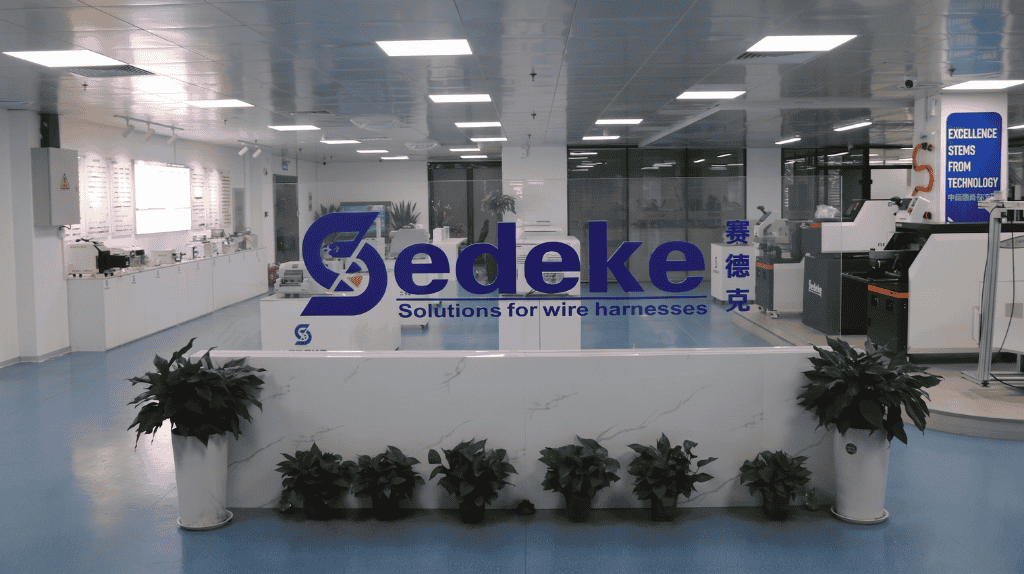
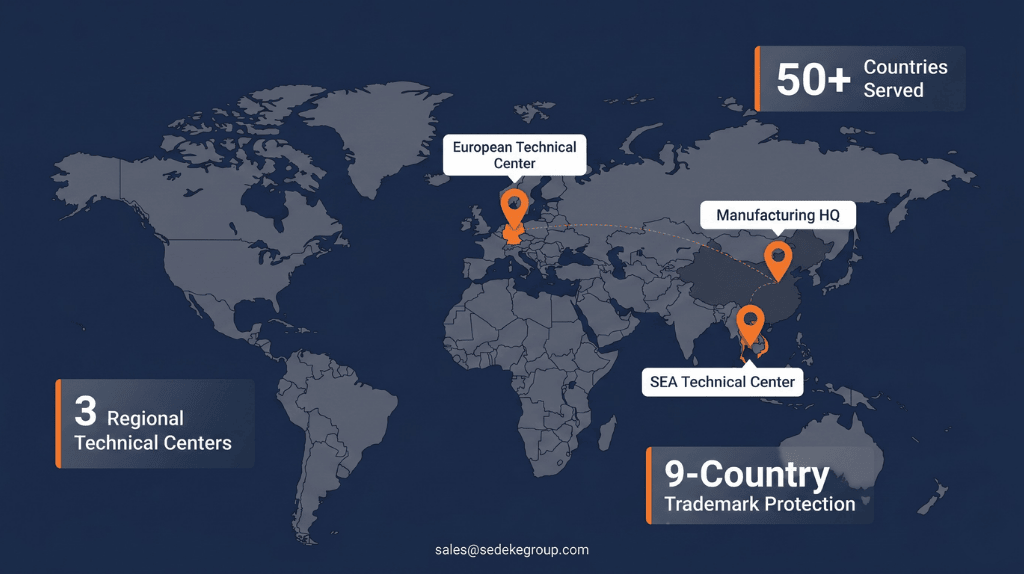
Sedeke's Edge: Sedeke operates three dedicated technical support centers strategically located in Europe and Southeast Asia. These centers provide localized engineering expertise, rapid access to critical spare parts, and bilingual (or multilingual) customer support, ensuring that your operations are never left waiting on an overseas response.
Trademark Protection Across Markets
Intellectual property and brand legitimacy are often overlooked during the procurement of industrial machinery, yet they are vital indicators of a supplier's reliability. A wire harness machine supplier with registered trademarks in your target markets demonstrates a long-term, legally binding commitment to that region.
Trademark registration protects you, the buyer, from inadvertently purchasing counterfeit equipment or dealing with unauthorized distributors who cannot honor warranties.
When a company invests in trademark protection across multiple international jurisdictions, it signals financial stability and a dedication to maintaining consistent quality standards globally. It ensures that the machine you purchase is genuine and backed by the manufacturer's official service network.
Sedeke's Edge: Sedeke has proactively secured trademark protection in 9 countries. This legal framework ensures that customers in Europe, Southeast Asia, and beyond receive genuine Sedeke equipment, backed entirely by authorized, highly trained service networks.
Communication Infrastructure
When evaluating a partner, you must assess the maturity of their communication infrastructure. Do they rely solely on a generic "info@" email address, or do they have a structured support ecosystem? Look for suppliers that offer multilingual support tailored to your region. They should provide multiple, integrated contact channels, including dedicated phone lines, video conferencing capabilities, and secure customer portals for tracking maintenance tickets. Most importantly, a reliable supplier will offer documented response commitments—known as Service Level Agreements (SLAs)—and assign dedicated account management teams to oversee your facility's specific needs.
Before signing a procurement contract, ask for a detailed breakdown of what parts are held in regional inventory versus what must be shipped from the manufacturing headquarters. A robust local inventory minimizes the need for expensive emergency freight and drastically reduces Mean Time To Repair (MTTR) for your wire processing equipment.
The Checklist: 5 Questions to Ask Your Wire Harness Machine Supplier
To standardize your evaluation process, use the following checklist during supplier interviews. The answers you receive will quickly reveal whether a manufacturer is truly equipped to support your international operations.
| # | Question | ? Red Flag Answer | ✅ Green Flag Answer | Why It Matters |
|---|---|---|---|---|
| 1 | How do you provide technical support in my region? | "We offer 24/7 remote support from China and will send a technician if absolutely needed." | "We have regional technical centers staffed with local engineers who can be on-site quickly." | Dispatching technicians from China involves visa processing, travel time, and timezone delays — all of which directly translate to extended production downtime. |
| 2 | What is your spare parts strategy internationally? | "Parts are shipped directly from our main factory; it takes 2–4 weeks depending on customs." | "We maintain a regional inventory hub; critical parts are delivered within 2–5 business days." | Customs delays are the single largest enemy of factory uptime. Regional inventory eliminates border dependency entirely for critical replacement parts. |
| 3 | How is training handled for overseas operators? | "We provide a basic English manual and online videos. On-site training is a heavy extra cost." | "Comprehensive on-site training or training at our regional center is included in the deployment." | Complex wire processing equipment requires hands-on learning to prevent operator-induced machine faults. Video-only training is insufficient for production-floor operators. |
| 4 | What are your QC and international standards? | "We manufacture strictly to Chinese domestic standards, which are just as good." | "Our machines are CE/UL certified, built to ISO standards, with documented pre-shipment testing." | Non-CE/UL certified equipment can void your factory's insurance policies or be rejected by local safety inspectors at the installation stage. |
| 5 | Can you provide references from regional customers? | "Due to privacy concerns, we cannot share information about our other clients." | "We would be happy to connect you with similar regional customers to discuss their experience." | A supplier with a successful local footprint will have regional customers willing to vouch for their support infrastructure. Refusal to provide references is a direct signal of limited regional presence. |
How SEDEKE's Regional Support Network Works
Understanding the theory of localized support is important, but seeing it in practice provides a clear benchmark for procurement. Sedeke has engineered its international operations specifically to solve the pain points experienced by European and Southeast Asian manufacturers using imported wire harness equipment.
3 Technical Centers: Europe + Southeast Asia
Rather than relying on third-party distributors to handle complex technical issues, Sedeke has invested heavily in proprietary infrastructure.
- European Technical Center: Strategically located to serve the EU manufacturing bloc, this center is staffed by EU-based engineers who speak multiple European languages. This facility possesses same-day field service capabilities for critical production halts, ensuring that European automotive and industrial manufacturers experience minimal disruption.
- Southeast Asian Technical Center: Positioned to support the booming electronics and automotive sectors in SEA, this center provides rapid response services to Vietnam, Thailand, Malaysia, and Indonesia.
- Regional Inventory Hubs: Attached to each technical center are dedicated regional inventory hubs. These hubs use predictive analytics
50+ Countries Coverage
While localized support is vital, global experience drives innovation. Sedeke's wire harness equipment serves demanding customers across more than 50 countries. This expansive footprint means Sedeke’s engineering teams have encountered and solved almost every conceivable wire processing challenge. This global knowledge base is shared across all technical centers, authorized service partners, and multilingual remote support teams, ensuring that a solution developed for a client in Germany can immediately benefit a client in Malaysia.
9-Country Trademark Protection
Sedeke’s commitment to its international markets is legally solidified through trademark registrations in 9 distinct countries. For procurement teams, this provides profound peace of mind. It guarantees that when you purchase Sedeke equipment, you are protected from counterfeit machinery, unauthorized resellers, and the intellectual property risks that often plague the global industrial equipment market.
Response Time Advantages
The ultimate metric of a support network is speed. The following table illustrates the stark contrast between a traditional, headquarters-only export model and Sedeke’s localized infrastructure:
| Support Scenario | ? Traditional HQ-Only Supplier | ✅ Sedeke Regional Support |
|---|---|---|
| Initial response to technical ticket | 12–24 hours (timezone gap) | 2–4 hours (local business hours) |
| On-site technician deployment | 3–7 days (visa processing + flights) | Same day to 2 days maximum |
| Critical spare parts delivery | 2–4 weeks (international freight + customs) | 2–5 business days (dispatched locally) |
For a facility running high-volume wire stripping machine manufacturer operations, the difference between waiting 7 days for a technician versus having one on-site the same day is measured in hundreds of thousands of dollars in preserved revenue.
Frequently Asked Questions
Q1: Why is a global support network crucial for my wire harness manufacturing business?
A: Equipment downtime directly and severely impacts your factory's profitability and your relationships with end-clients. A global support network with localized regional centers ensures vastly faster access to technical expertise, hands-on troubleshooting, and critical spare parts, thereby maximizing your machine uptime and overall equipment effectiveness (OEE).
Q2: How can I verify a Chinese supplier's claimed regional presence before purchasing?
A: Do not take marketing claims at face value. Request the physical addresses of their regional centers, ask for documentation of their local staff's engineering qualifications, request a tour (virtual or physical) of their regional parts inventory, and most importantly, demand references from existing customers operating within your specific region.
Q3: What guarantees do you offer for spare parts availability in Europe and SEA?
A: Sedeke maintains robust, data-driven regional inventories at our three technical centers. By tracking the usage rates of consumables and mechanical parts in your region, we ensure that critical components are stocked locally and are available for delivery to your facility within 2 to 5 business days, bypassing international customs delays.
Q4: How do you address language barriers and cultural communication differences?
A: Effective technical support requires clear communication. Sedeke directly employs multilingual engineers at our regional technical centers. Furthermore, all our technical documentation, machine software interfaces (HMI), and training modules are available in multiple languages to ensure your local operators fully understand the equipment.
Q5: What level of training is provided for new machine installations overseas?
A: We believe a machine is only as good as its operator. Sedeke provides comprehensive, multi-tiered training. This includes hands-on training at the customer site during installation, advanced workshops at our regional centers, and ongoing remote live support—all conducted by certified Sedeke engineers to ensure your team is confident and capable.
Conclusion
Choosing a wire harness machine supplier is not merely a transactional purchasing decision; it is the formation of a long-term operational partnership. For manufacturing operations based in Europe and Southeast Asia, a supplier's ability to provide responsive, localized support often determines whether your capital equipment investment delivers sustained, profitable value or becomes a logistical liability.
The hidden costs of timezone-only support cannot be ignored. From devastating production downtime and exorbitant emergency shipping expenses to the severe shortening of your equipment's lifecycle, the operational risks can easily outweigh any initial CapEx savings gained from choosing a lower-priced, unsupported supplier.
Procurement teams must shift their focus from the initial price tag to the Total Cost of Ownership, prioritizing regional infrastructure as a non-negotiable requirement.
Sedeke's established network of three dedicated technical centers across Europe and Southeast Asia, combined with our proven operational coverage across 50+ countries and rigorous trademark protection in 9 nations, represents a supplier partnership built expressly for sustained international success.
We bridge the gap between world-class manufacturing technology and localized, immediate operational support. Ready to enhance your wire harness production with a reliable, truly global partner that understands your local needs?
Request a Machine Quote | [email protected]