

Choose a semi-automatic terminal crimping machine when you need frequent changeovers, short runs, or operator control over varied wire and terminal jobs. Choose a fully automatic machine when a stable product can justify integrating wire feeding, cutting, stripping, and one-end or two-end crimping into one production sequence.
The choice depends on what enters the machine, what must come out, and how long you can run the same setup. A fast press and a complete wire-processing line do not measure output in the same way, so their headline speeds are not directly comparable.
Quick comparison
| Decision area | Semi-automatic terminal crimping | Fully automatic terminal crimping |
|---|---|---|
| Typical input | Prepared wire end and terminal strip or individual terminal | Wire from a reel or feeding system, plus terminal supply |
| Process scope | Usually terminal feeding and crimping; stripping may happen at another station or in an added module | Model-dependent measuring, cutting, stripping, crimping, and optional extra processes |
| Operator role | Loads or positions wire, starts the cycle, removes the part, and performs scheduled checks | Loads bulk material, selects the job, handles changeover, responds to alarms, and performs quality checks |
| Best starting point | High product variety, short batches, frequent engineering changes, or special manual handling | Stable, repeatable products with enough run length to use the integrated line effectively |
| Changeover | Often localized to the terminal, applicator, wire guide, and press setting | May involve wire path, blades, guides, terminal feed, applicators, end configuration, and software recipe |
| Output measure | Accepted crimps per staffed hour or shift | Accepted finished leads per staffed hour or shift |
| Space and utilities | Usually a smaller workstation, with requirements depending on the press | Larger system footprint with material handling, guarding, power, compressed air, and service access |
| Investment decision | Equipment, applicator, preparation equipment, labor, inspection, and work-in-process | Complete installed line, tooling, options, training, maintenance, availability, and changeover loss |
Neither column is a quality grade. A semi-automatic press can produce an approved crimp when the wire, terminal, applicator, settings, and inspection plan are correct. A fully automatic line can still make unacceptable parts if the setup or material drifts. Automation changes the process and labor model. It does not remove the need for crimp validation.
What semi-automatic and fully automatic mean
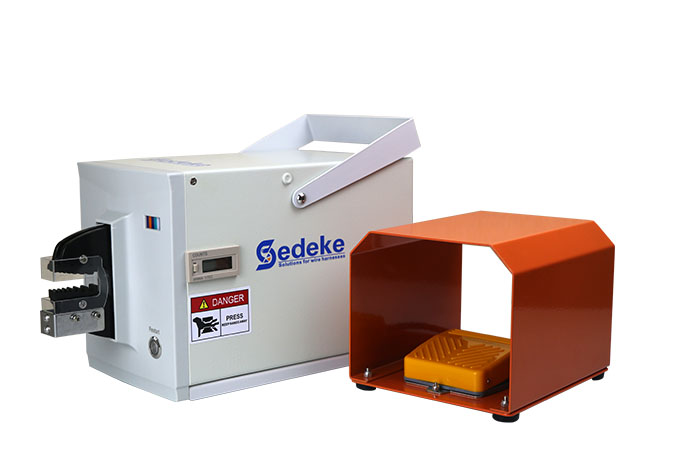
A semi-automatic crimping press automates the crimp cycle
At a typical semi-automatic workstation, an operator brings a prepared wire to the press and positions it in the terminal. The terminal may feed through an applicator, while the press supplies the controlled crimping stroke. The operator then removes the finished part and continues with the next wire.
The wire may already be cut and stripped. In another cell, cutting and stripping may happen on separate machines before the wire reaches the press. Some semi-automatic systems add stripping, seal handling, or data functions, so the exact boundary must be stated in the quotation.
A servo drive, recipe screen, barcode connection, or stored production history can improve control and traceability. These features do not by themselves turn a standalone press into a fully automatic wire line. The physical material flow still determines the automation level.
A fully automatic machine joins several processes
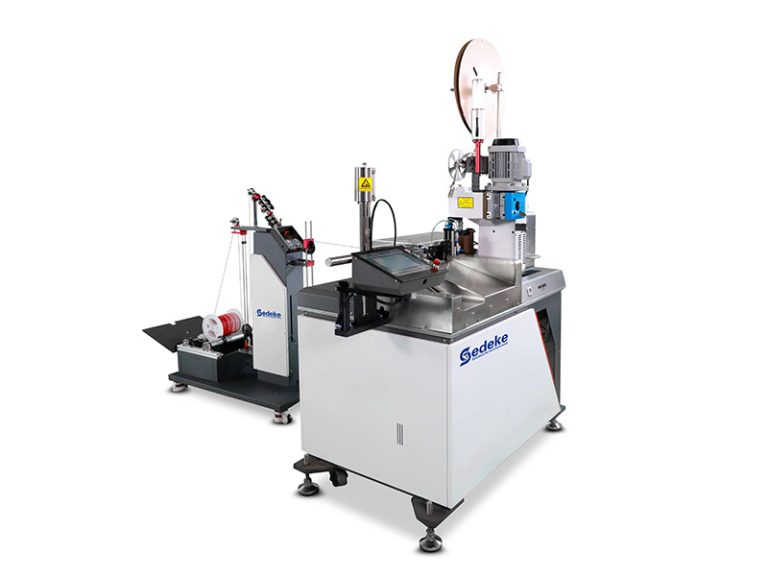
A fully automatic cut-strip-crimp machine normally starts with wire from a reel or feeding system. It measures and cuts the wire, strips the required end or ends, presents the terminal, and completes the configured crimp process. A single-end machine and a double-end machine are different routes, not minor versions of the same job.
Depending on the equipment, the process may also include twisting, seal insertion, tinning, marking, or another station. Do not assume these operations are standard because they appear in a manufacturer’s wider product range. Define each required station and ask the supplier to identify the exact model and options in the proposal.
Full automation reduces manual transfers between separate operations. It also concentrates more of the production route in one line. When that line stops or changes over, several operations stop together. Availability, recovery time, spare parts, and trained maintenance therefore matter more than a brochure cycle rate.
Eight factors that should decide your automation level
1. Define the process boundary first
Write the process as a sequence before comparing machines. For example:
wire reel -> measure -> cut -> strip A end -> strip B end -> crimp A end -> crimp B end -> inspect -> collect
Your actual sequence may omit one crimp, add twisting, or require a weather seal. Once the sequence is visible, you can see which steps must be automatic and which steps can remain operator assisted.
If your factory already has reliable cutting and stripping capacity, a semi-automatic crimping cell may solve the real bottleneck. Buying a complete line would duplicate equipment unless the integrated flow creates enough labor, handling, or quality benefit to justify the change.
2. Compare stable run length, not annual volume alone
Annual volume can hide an awkward production mix. One million leads divided among hundreds of wire-terminal combinations creates a different automation problem from one million identical leads.
For each product family, record the batch size, number of batches, average run time, and expected design changes. Full automation becomes more attractive when the machine can stay on an approved setup long enough to recover the time used for changeover and first-piece approval. Semi-automatic cells often remain useful when work arrives in short, varied orders.
There is no universal volume threshold. Your threshold depends on the number of products, labor content removed, availability, changeover time, scrap during setup, and installed project cost.
3. Count every changeover task
A semi-automatic press change may involve an applicator, crimp height, wire guide, terminal strip, and first-piece inspection. A full line may also require wire-path setup, blades, feeding components, end configuration, optional process stations, and collection settings.
Ask the supplier to demonstrate a change between two representative jobs. Time the complete event from the last accepted part of Job A to the first accepted part of Job B. A tooling change without quality approval is not a complete changeover.
Recipe storage can shorten parameter entry, but it cannot replace worn-tool checks, material verification, or the physical change parts required for a different terminal and wire.
4. Check how the wire and terminal behave in the machine
Wire size is only one input. Include conductor construction, insulation material, outside diameter, roundness, surface sensitivity, required strip length, and minimum bend radius. A soft or highly flexible wire may need different feeding and support from a stiff single conductor.
For the terminal, provide the part number, drawing, carrier-strip format, pitch, feed direction, material thickness, and approved applicator information. Loose contacts, ferrules, side-feed terminals, end-feed terminals, and flag terminals require different handling.
Run the smallest, largest, and most difficult products in the planned range. A trial on the easiest sample does not establish the entire process window.
5. Measure accepted finished output
A semi-automatic press may publish strokes per minute. A full line may publish finished pieces per hour for a defined wire length. These values describe different process scopes.
Use one common production measure:
accepted finished leads per staffed shift
Calculate it after changeovers, planned inspection, normal replenishment, expected minor stops, and reject handling. Keep the assumptions visible. If a supplier provides an output figure, ask which wire length, terminal, end process, inspection steps, and operating conditions produced it.
The same rule applies to labor. Full automation may reduce direct handling at one station, but it still needs material loading, setup, monitoring, quality approval, maintenance, and fault recovery. Count the work that remains.
6. Set quality and traceability requirements
Define the acceptable connection before choosing the control package. Your plan may include visual strip inspection, crimp height, pull force, and cross-section analysis. The terminal supplier’s application specification or your approved drawing should set the acceptance values.
If you require crimp force monitoring, automatic alarms, reject separation, barcode scanning, recipe control, MES communication, or historical records, list each function separately. Confirm whether it is standard, optional, customized, or supplied as external equipment.
Do not assume that a fully automatic line includes every quality function. Do not assume that a semi-automatic cell lacks traceability. The Sedeke TM-T servo terminal crimping series, for example, publishes recipe and historical crimping records, while its network, MES, scanner, and ERP connections are configuration items that need confirmation.
7. Plan for maintenance and disruption
A standalone press affects one operation. If it stops, production may be able to move to another compatible workstation. A fully automatic line connects several operations, so one fault can interrupt the complete lead-making route.
Compare preventive maintenance, daily cleaning, applicator service, blade life, wear parts, spare-part lead time, troubleshooting access, software backup, and local technical support. Ask who can restore production after a terminal jam, feeding fault, bad strip, or failed sensor.
Include fault recovery in the production model. A line that is fast while running but difficult to restart may miss the output assumed in the investment case.
8. Calculate the incremental project return
Compare the extra cost of full automation with the extra verified benefit it creates over the semi-automatic alternative.
incremental payback period = installed cost difference / annual verified net savings
The installed cost difference should include the machine, applicators, feeders, blades, change parts, software, quality options, installation, training, commissioning, floor preparation, power, air, and initial spare parts.
Annual net savings may include direct labor removed, fewer transfers, lower work-in-process, or measured scrap reduction. Subtract added maintenance, service, energy, consumables, changeover loss, financing, and the cost of downtime risk. Use your own rates and a validated sample process. A generic online ROI percentage is not suitable for an equipment approval.
Run at least three scenarios: planned case, lower-volume case, and disruption case. If full automation only works in the most optimistic case, the project needs a stronger operating plan or a different automation level.
The middle option: strip and crimp in one cycle
The choice is not limited to a crimp-only press or a full cut-strip-crimp line. A strip-and-crimp machine accepts an already cut wire end, strips the insulation, and crimps the terminal in one cycle. The operator still presents the wire, but the work no longer moves between a separate stripper and crimp press.
This route can fit production where automatic wire cutting is unnecessary or already handled elsewhere, yet repeated strip and crimp transfers create labor or positioning problems. It can also address dedicated cable constructions that do not fit a general press.
Sedeke’s Strip Crimp range separates standard single-wire, multi-core, and weather-seal processing paths. The route is still based on prepared wire. If you need automatic measuring and cutting from a reel, compare the Cut Strip Crimp category instead.
For a broader explanation of terminal and machine classes, see the automatic stripping and crimping machine manufacturer guide.
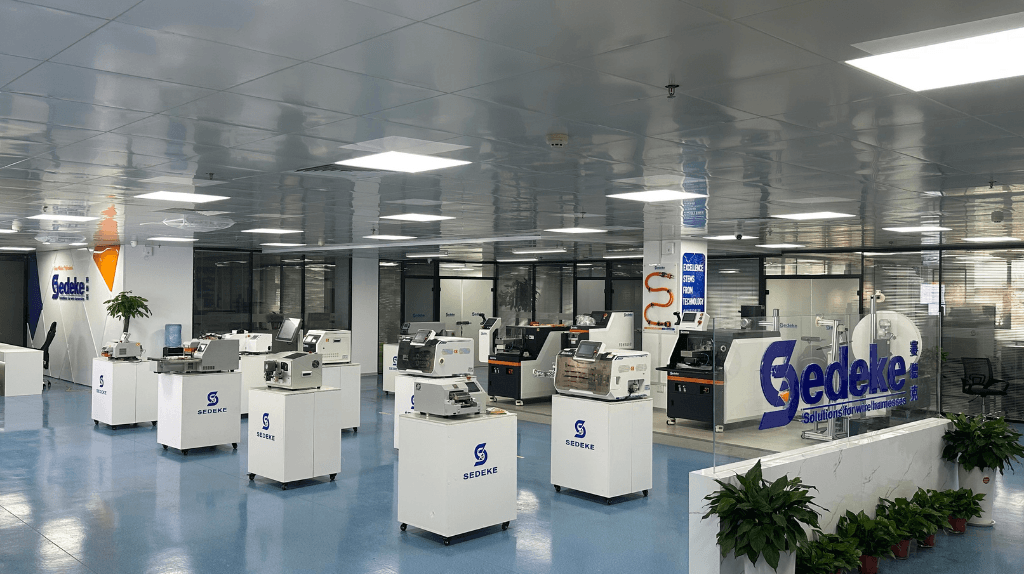
How Sedeke maps the three equipment routes
Standalone terminal crimping presses
The Sedeke Terminal Crimping Machine category is the starting point when crimping is the main station you need to configure. The category covers general presses, servo systems, ferrule equipment, pneumatic routes, and connector-specific machines. Selection starts with the terminal, wire, applicator, crimp shape, stroke, and force requirement.
TM-20S is one standalone example, with a published 20 kN pressure and 30 or 40 mm stroke. The TM-T servo series is a different control route for jobs that need stored recipes and crimping history, with optional production-system connections. Neither example should be selected from press force or data features alone.
Prepared-wire strip-and-crimp cells
Use this route when the wire is already cut but you want stripping and terminal crimping at one station. Confirm whether the application uses standard single wire, exposed conductors in a sheathed multi-core cable, or a weather seal before selecting a model.
This option can reduce handling without adding the full material-feeding and cutting scope of an automatic line.
Fully automatic single-end and double-end lines
ACC-101 is Sedeke’s single-end Cut Strip Crimp route. Its published process includes wire cutting, one- or two-end stripping, single-end crimping, and single-end twisting.
ACC-102A is the double-end route. It feeds wire to length, cuts it, strips both ends, and crimps both ends in one machine sequence. The Cut Strip Crimp category includes other process combinations, but their functions are model specific.
For either ACC route, confirm the wire range, terminal format, applicator, strip length, end design, required options, output conditions, and acceptance plan with your actual samples.
Which route fits your production?
| Production situation | First route to evaluate | Why | Main risk to test |
|---|---|---|---|
| Many terminal and wire changes, short orders | Standalone semi-automatic crimping cell | Keeps changeover local and allows operator handling of varied work | Labor dependence, setup control, and upstream preparation |
| Prepared wire with repeated stripping and crimping | Strip-and-crimp cell | Combines two operations without adding automatic cutting | Wire presentation, strip quality, terminal feed, and operator cycle |
| Stable product with one terminal end | ACC-101 type single-end route | Integrates cutting, stripping, and single-end crimping | Other-end process, wire feeding, changeover, and accepted output |
| Stable product with terminals on both ends | ACC-102A type double-end route | Integrates the complete two-end sequence | End configuration, applicators, quality controls, and line availability |
| Frequent special seals, multi-core cable, or unusual contacts | Dedicated process review | May need a specialized Strip Crimp, Cut Strip Crimp, or customized route | Assuming a standard machine can handle the construction |
| Strong recipe and traceability need but varied manual work | Controlled servo press or cell | Adds setup records without forcing all material handling into one line | Which data functions are included and how records are validated |
Treat the table as a starting point. A representative sample trial and a complete quotation are what turn the route into an equipment decision.
RFQ and sample checklist
Send the same input to every proposed Sedeke route:
- wire drawing, part number, physical samples, conductor size, strand construction, insulation, outside diameter, and minimum bend radius;
- terminal drawing, part number, carrier-strip format, pitch, feed direction, material, applicator information, and samples;
- finished lead drawing with cut length, tolerance, strip lengths, crimped end or ends, seal, twist, tinning, and marking requirements;
- smallest, largest, and most difficult products in the planned range;
- annual demand, batch size, batches per shift, run length, product-change frequency, and target accepted output;
- required crimp height, pull force, cross-section, CFM, reject handling, recipe, barcode, and traceability functions;
- current process steps, number of operators, inspection frequency, measured scrap, and known bottleneck;
- factory voltage, frequency, compressed air, floor-space limit, material flow, and service access;
- requested tooling, spare parts, installation, training, sample evaluation, FAT, warranty, service, and delivery scope.
Contact Sedeke with this package. Ask the technical team to return a process map, proposed model and configuration, tooling list, sample plan, acceptance criteria, and current quotation. This gives you enough information to compare the semi-automatic, Strip Crimp, and fully automatic routes on the same basis.
FAQ
Is a fully automatic terminal crimping machine always faster?
It usually automates more operations, but the useful comparison is accepted finished leads per staffed shift. Include changeover, inspection, replenishment, minor stops, reject handling, and wire length. A press stroke and a finished lead are not equivalent units.
Does full automation always improve crimp quality?
No. Crimp quality depends on the wire, terminal, applicator, press setting, material condition, and inspection plan. Full automation may control handling and process sequence, but it still needs a validated setup and ongoing checks.
When is a semi-automatic crimping machine the better choice?
It is often the first route to test when you have frequent product changes, short batches, special manual handling, or reliable upstream cutting and stripping equipment. Confirm the labor and quality controls that remain at the workstation.
When should you consider a fully automatic line?
Consider it when the product is stable enough to use the integrated line for meaningful run time and the removed handling, labor, or work-in-process justifies the installed cost and maintenance risk. Use actual jobs in the calculation.
What is the difference between single-end and double-end automatic crimping?
A single-end line crimps one wire end within its configured process. A double-end line strips and crimps both ends. The second terminal, applicator, end design, and quality checks add process requirements, so you should define both ends in the RFQ.
Can a semi-automatic machine include recipe and traceability functions?
Yes. Control and data features do not define the complete material-flow automation level. Sedeke’s TM-T series publishes stored recipes and crimping history, with network and production-system connections listed as configuration items.
Is Strip Crimp the same as full automation?
No. A Strip Crimp machine combines stripping and terminal crimping for a prepared wire end. A full Cut Strip Crimp line starts with wire feeding and adds automatic measuring and cutting before the end processes.
How do you get a reliable price comparison?
Request current quotations against the same process map, samples, tooling, quality options, installation, training, FAT, spare parts, warranty, and service scope. A bare machine price does not show the total installed project.
Final thoughts
Choose the least complicated automation level that can meet your accepted output, quality, labor, and traceability requirements with enough operating margin. Semi-automatic equipment is not merely a step toward full automation. For high-mix work, it may remain the more productive long-term choice. Full automation earns its place when your product and run structure can use the complete process consistently.
Sedeke covers standalone terminal presses, prepared-wire Strip Crimp equipment, and automatic single-end or double-end Cut Strip Crimp routes. Send your wire, terminal, finished lead drawing, batch pattern, quality plan, and site conditions for a model review and current quotation.