

Choosing the best automatic stripping and crimping machine manufacturer starts with the connection you need to make. A machine built for wire-end ferrules is not a substitute for an open-chain terminal press. A bench-top strip-and-crimp unit is also not the same as a line that cuts wire and processes both ends automatically.
This guide compares six manufacturers with current, identifiable products in these categories. It is an application-based shortlist, not a ranking by revenue, market share, or brand popularity. Sedeke publishes this guide and is one of the manufacturers included, so each entry links to the manufacturer’s own product information and states where that equipment fits.
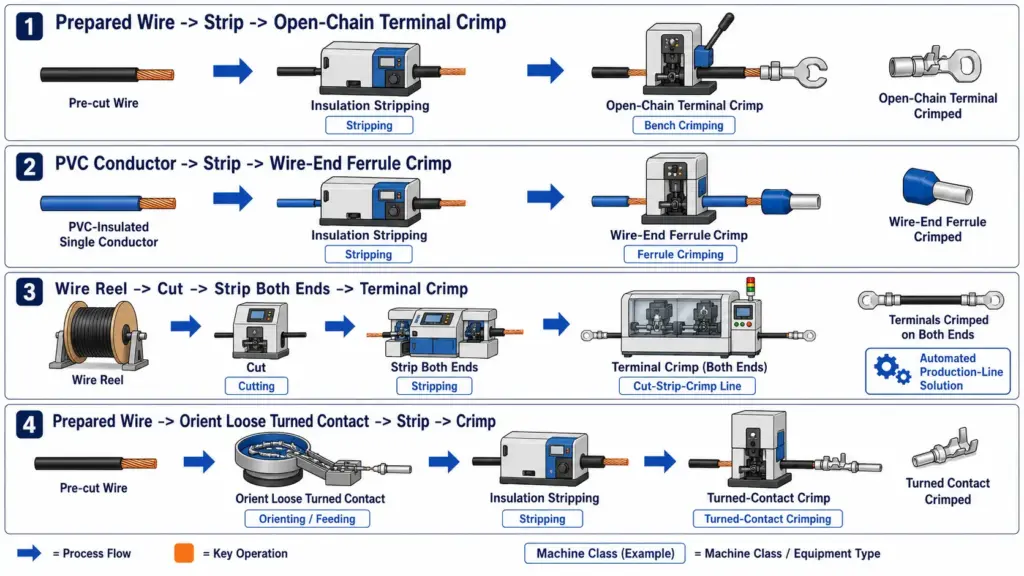
First decide which machine class you need
The phrase “automatic stripping and crimping machine” covers several machine types. If you put them in one comparison, the specifications will tell you very little.
Strip and crimp a prepared wire
In this setup, an operator presents an already cut wire end to the machine. The machine strips the insulation and crimps a terminal in one cycle. This is a common route for open-chain terminals when you want to combine two operations at one workstation without moving to a full wire-processing line.
This is the main category covered by Sedeke’s Strip Crimp range. It can suit repeated batches, mixed wire sizes, and applications in which the operator still controls wire presentation.
Strip and crimp a wire-end ferrule
Panel builders often need a compact machine that strips a PVC conductor and applies a ferrule. Ferrules may be supplied on a reel, and the machine range is usually defined around conductor cross-section and ferrule format.
Do not shortlist a ferrule machine for open-chain stamped terminals unless the manufacturer confirms that exact terminal system. The feed method, tooling, and crimp geometry are different.
Cut, strip, and crimp automatically
A fully automatic line starts with wire from a reel or feeding system. Depending on the configuration, it can measure, cut, strip, apply seals, and crimp one or both ends. This is a different investment and production model from a machine that accepts a prepared wire.
You should compare process stations, end configurations, changeover, quality monitoring, and output under your actual job conditions. A bench-top cycle rate and a complete line output are not comparable.
Process loose contacts, seals, or special cable constructions
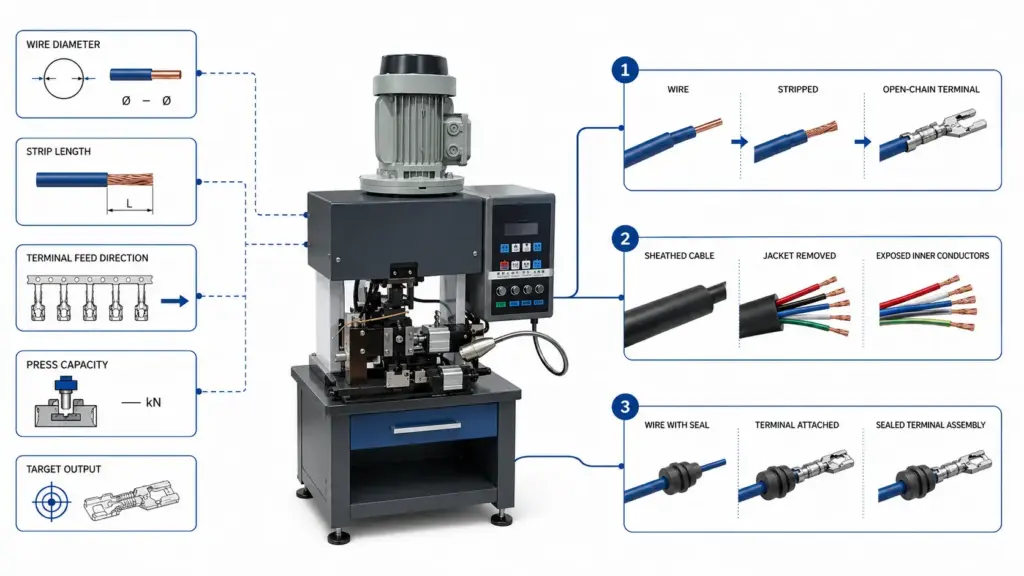
Loose turned contacts need orientation and selective feeding. Weather-sealed connections need the seal positioned before terminal crimping. Sheathed multi-core cables require control of the outer jacket and each exposed inner conductor. These jobs often require a dedicated machine path, not a universal option added to any strip-and-crimp unit.
How these manufacturers were selected
Each manufacturer in this guide met four practical conditions:
- The manufacturer has a current official page for an identifiable stripping and crimping product or product family.
- The published information shows which terminal, contact, wire, or automation route the equipment serves.
- The product combines stripping and crimping, or belongs to a clearly defined automatic cut-strip-crimp platform.
- There is enough public information to explain the fit without relying on a third-party ranking.
The list does not measure market share, sales volume, installed base, or independent machine quality. Those figures were not available as a consistent primary dataset across all six companies. “Best” therefore means best suited to a defined application and buying requirement.
Quick comparison of six manufacturers
| Manufacturer | Best fit to evaluate | Automation boundary | Terminal or application | Confirm before you buy |
|---|---|---|---|---|
| Sedeke | Flexible prepared-wire strip-and-crimp work, including standard wire, multi-core, and weather-seal paths | Operator presents prepared wire in the Strip Crimp category | Open-chain terminals, exposed multi-core conductors, selected sealed-wire processes | Wire and terminal match, feed direction, press configuration, tooling, sample result |
| Komax Group | Higher automation and complete wire-processing platforms | Model-dependent cutting, stripping, crimping, seal insertion, and other stations | Crimp-to-crimp production, mixed batches, larger wires, or special processing by model | Required stations, end design, quality options, line configuration, service scope |
| Schäfer Group | Configurable strip, crimp, seal, and special-process systems | Semi-automatic through customized automation, depending on product family | Individual wires, multi-core cables, seals, and special terminals | Machine family, applicator, press force, quality functions, custom engineering |
| Zoller+Fröhlich | Loose male and female turned contacts | Prepared wire with selective contact feeding | Loose contacts that need orientation before crimping | Contact geometry, feeder qualification, tooling, wire range, monitoring option |
| Weidmüller | Ferrule processing in panel building | Compact electrical strip-and-crimp workstation | PVC conductors with wire-end ferrules on reel | Ferrule system, cross-section, strip/crimp length, workplace integration |
| GLW | Ferrule processing across several conductor bands | Compact stripping and crimping machines | Wire-end ferrules | Machine range, ferrule specification, conductor construction, setup and service |
Six manufacturers worth evaluating
Sedeke: flexible open-chain terminal, multi-core, and weather-seal paths
Sedeke’s Strip Crimp range is the most relevant starting point when you have prepared wire lengths and want to strip and crimp at one station. The current range separates standard single-wire, sheathed multi-core, and weather-seal applications instead of presenting one machine as suitable for every cable.
For fine single wires, the TM-15SC and TM-20SCS pages list AWG 32 to 18, while the TM-30SC extends the listed range to AWG 32 to 14. TM-80SCS covers a different requirement, with a listed 0.8 to 8.0 mm wire range and an 8T press. These figures help you choose a starting model, but they do not replace a terminal and tooling check.
The TM-20SCM is the dedicated route for sheathed multi-core cable in the current range. Its published specifications list cable diameters from 0.8 to 4.0 mm and up to 12 cores. TM-200SC and TM-200SCT add weather-seal feeding before stripping and crimping for a listed 1 to 4 mm wire range.
Sedeke belongs on your shortlist when these application paths match your work and you want model choices across them. It is not the correct comparison category if your project must start from a wire reel, cut every length, and process both ends without operator presentation. For that requirement, review a Cut Strip Crimp system instead.
Before you request a quote, confirm the terminal feed direction, press configuration, tooling, strip length, and quality checks for the ordered setup. Published output also needs to be checked with your wire and terminal because cycle rate changes with the material and process conditions.
Komax Group: higher automation and cut-strip-crimp platforms
Komax Group’s automatic crimping portfolio is relevant when your project needs more than a prepared-wire workstation. Its official page describes model-dependent combinations of cutting, stripping, crimping, seal insertion, tinning, and twisting.
The portfolio covers several production patterns rather than one standard machine. The listed systems include crimp-to-crimp production, high-mix work, seal processing, larger conductor cross-sections, and special process stations. That breadth makes Komax a logical company to evaluate for a complete automated line.
Your main task is to define the required stations before comparing models. A line with two-end processing, seal modules, inspection, and data interfaces should not be compared with a simple strip-and-crimp cycle on headline speed or machine price. Ask for a proposed process layout and an acceptance test based on representative jobs.
Schäfer Group: configurable strip-crimp-seal systems
Schäfer Group’s crimping machine range separates several process families. Its current page lists StripLine for cable preparation functions, TransLine for stripping and crimping with extended quality functions, and SealLine configurations for seal and crimp processes.
This makes Schäfer worth evaluating when your connection needs a more specialized sequence or when the applicator, quality checks, and cable handling must be engineered together. The company also lists systems for multi-core and special connector applications.
Do not treat the family name as proof that a standard configuration supports your terminal. Send the terminal drawing, cable construction, required press force, and inspection criteria. Ask which machine, applicator, and options form the proposed process.
Zoller+Fröhlich: loose turned contacts
The Zoller+Fröhlich AM 05 addresses a specific problem: processing loose male and female contacts. Its selective feeding unit orients contacts before they enter the stripping and crimping process.
The official page lists an electropneumatic drive, storage for up to 50 programs, a 0.25 to 4 mm² crimping range with a 6 mm² extension shown in parentheses, and optional crimp force monitoring. This is useful public information for an initial screen, but the contact geometry and feeder qualification remain decisive.
Put Zoller+Fröhlich on your list when loose-contact orientation is part of the job. It is not a direct substitute for a machine designed around open-chain terminals on carrier strip or ferrules on reel.
Weidmüller: wire-end ferrules for panel building
Weidmüller’s CRIMPFIX ECO is a focused ferrule machine for panel-building work. The official page specifies PVC conductors with wire-end ferrules on reel and a listed cross-section range of 0.5 to 2.5 mm².
Its electrical drive and compact format suit a workstation where operators prepare cabinet wires in repeated cross-sections. The published page also states that the machine strips and crimps in less than 1.5 seconds, but you should interpret that figure within this exact ferrule process, not compare it with a terminal press or complete cut-strip-crimp line.
Choose this route when your material and connection are within the ferrule system. If you process open-chain terminals, loose contacts, weather seals, or multi-core cable ends, use a manufacturer and machine family designed for that connection.
GLW: ferrule processing across several conductor bands
GLW’s stripping and crimping category also focuses on ferrules. The current page lists the MC 40-1 at 0.5 to 1.5 mm², with an optional 0.25 to 4 mm² range, the MC 40L at 4 to 10 mm², and the MC 25 at 0.5 to 2.5 mm².
Those published bands give you a quick way to identify a candidate machine for small, common, or larger ferrule applications. You still need to confirm the conductor construction, ferrule specification, strip length, tooling, and local service arrangement.
GLW is worth evaluating when ferrules are the defined connection and you want several machine ranges within that category. Its public information should not be extended to stamped open-chain terminals or other contact families.
How to choose the right manufacturer for your production
Start with the terminal or contact
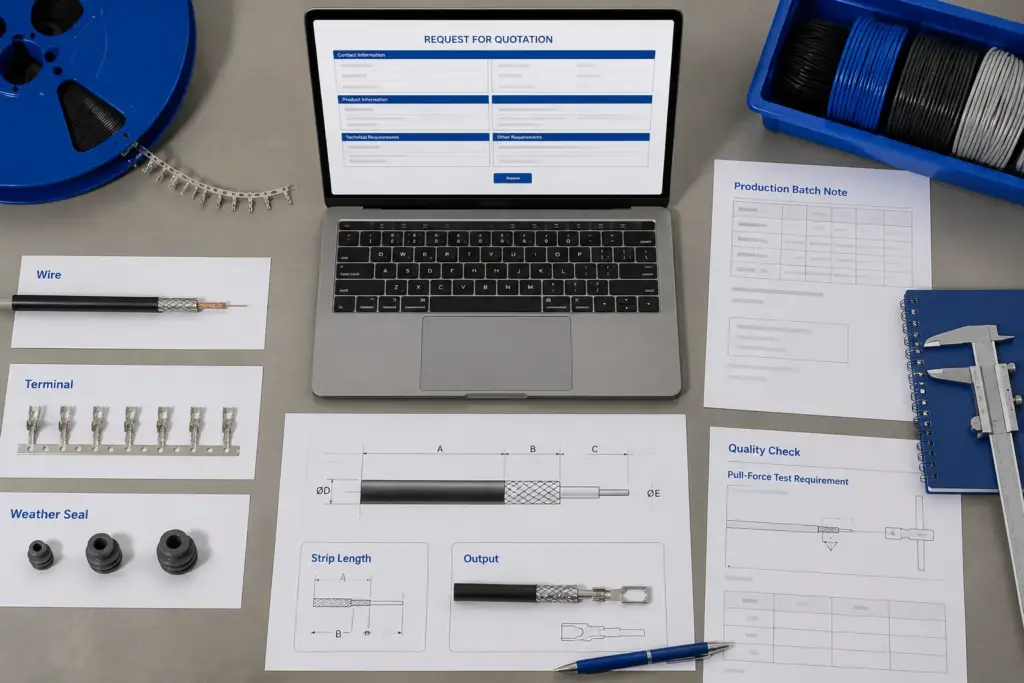
Send the manufacturer a drawing, part number, and physical sample if possible. State whether the component is an open-chain terminal, a ferrule, a loose turned contact, a weather-sealed terminal, or another connection. This one decision will remove many unsuitable machines from your list.
The terminal feed format matters as much as its electrical size. A reel-fed terminal, a side-feed chain, an end-feed chain, and a loose contact require different presentation and tooling.
Describe the wire and cable construction
Give the conductor cross-section or AWG, overall diameter, strand construction, insulation material, and required strip length. For sheathed cable, include the outer jacket, number of inner cores, exposed length, and the processing required on each core.
Nominal size alone is not enough. Two wires with the same conductor cross-section can behave differently during clamping and stripping because their insulation and strand construction differ.
Fix the automation boundary
Write down where the process starts and ends. Does an operator insert a cut wire? Does the machine need to measure and cut from a reel? Do you need one end or both ends processed? Must it insert a seal, twist strands, tin the conductor, or perform another step?
This definition prevents you from paying for unnecessary stations or selecting a machine that leaves a required operation manual.
Confirm tooling and feed compatibility
Ask which applicator, blades, guides, terminal feed, and change parts are included in the quotation. If you already own applicators or terminal tooling, do not assume they fit the proposed press. Request written compatibility confirmation.
Also ask how the machine changes between jobs. The answer should cover the parts that must be changed, the settings that can be recalled, the expected setup procedure, and the first-piece checks.
Define quality acceptance before you compare offers
Specify the checks required for the finished connection. These may include strip quality, crimp height, pull force, and cross-section analysis. If you need crimp force monitoring, traceability, automatic rejection, or a data interface, list each one as a requirement instead of assuming it is standard.
Ask every manufacturer to test the same representative jobs and report the same measurements. A sample that only looks acceptable in a photograph does not establish process capability.
Compare output under the same conditions
Headline cycle rates may exclude wire loading, unloading, changeover, inspection, or upstream cutting. Create one job definition and ask each supplier for expected output under that condition. Include wire length, terminal, seal, process steps, operator involvement, inspection frequency, and batch size.
For high-mix production, changeover and first-piece approval may matter more than maximum strokes per hour. For long stable runs, feeding reliability, scrap handling, maintenance access, and quality monitoring can have greater influence.
Compare the complete project scope
The lowest machine price may not be the lowest project cost. Compare applicators, feeders, blades, software, installation, training, spare parts, sample trials, acceptance testing, service response, and future terminal changes.
Use the current quotation for commercial decisions. Price, lead time, warranty, and included services can change by configuration and destination, so they should not be copied from an old project or a generic online figure.
Why Sedeke Is More Than a Single-Machine Supplier
Sedeke provides more than standalone stripping and crimping machines. Its equipment range covers wire cutting, stripping, terminal crimping, seal insertion, applicators, and crimp inspection, allowing buyers to configure a more complete wire-processing route.
Application-Based Machine Selection
Sedeke separates equipment by wire construction, terminal format, and automation level. Different solutions are available for:
- standard single wires with open-chain terminals;
- sheathed multi-core cables;
- weather-sealed wire ends;
- prepared-wire strip-and-crimp work;
- automatic cut-strip-crimp production.
This reduces the risk of selecting a machine that matches the wire size but not the actual terminal or process.
Applicator and Tooling Support
Terminal feed direction, carrier format, press stroke, shut height, and applicator compatibility directly affect crimp stability. Sedeke can review the terminal drawing and samples before confirming the press, applicator, blades, guides, and feeding configuration.
Sample Testing Before Delivery
Wire size alone cannot prove process compatibility. Insulation hardness, conductor structure, terminal geometry, and seal dimensions may all affect the result.
Sedeke can test representative samples to verify:
- stripping quality and conductor condition;
- terminal feeding stability;
- crimp profile and crimp height;
- seal positioning;
- expected production output.
This gives buyers a clearer technical basis before placing an order.
Crimp Quality Inspection
Sedeke also supplies equipment for crimp-height measurement, terminal pull-force testing, and terminal cross-section analysis. These inspection methods help buyers evaluate finished connections using measurable quality criteria rather than appearance alone.
Project Configuration Support
A complete project may include machines, applicators, tooling, feeders, inspection equipment, spare parts, and training. Sedeke can review the full application and recommend a configuration based on the wire, terminal, output target, quality standard, power supply, and compressed-air conditions.
When Sedeke Belongs on Your Shortlist
Sedeke should be evaluated when the project requires more than a generic stripping and crimping machine. Its main advantage is the ability to match different wire constructions, terminal systems, automation boundaries, and inspection requirements with separate processing routes.
Sedeke is particularly relevant when you need to:
- strip and crimp fine or standard single wires with open-chain terminals;
- process exposed inner conductors from a sheathed multi-core cable;
- insert a weather seal before stripping and terminal crimping;
- configure an applicator for a specific terminal feed direction;
- add crimp-height, pull-force, or cross-section inspection;
- move from operator-loaded wire processing to a complete cut-strip-crimp system.
The machine model still depends on the actual wire, terminal, applicator, strip length, press force, output target, and quality standard. A published wire range only provides an initial screening reference.
If production begins with prepared wire, Sedeke can review the requirement against its Strip Crimp equipment. If the process must begin from a wire reel and include automatic measuring, cutting, stripping, and one-end or two-end crimping, the project should be evaluated against the Cut Strip Crimp range instead.
Before quotation, Sedeke should receive representative samples and drawings. The technical review can then confirm the machine platform, tooling, applicator, processing sequence, sample-test method, quality checks, and complete quotation scope.
This makes Sedeke a practical candidate for buyers who need an application-specific wire-processing solution rather than an off-the-shelf machine selected only by headline speed or press force.
FAQ
Who makes automatic stripping and crimping machines?
Sedeke, Komax Group, Schäfer Group, Zoller+Fröhlich, Weidmüller, and GLW all publish identifiable equipment in this broad category. They do not all build the same machine type. Your shortlist should depend on the terminal, wire, process steps, and automation level.
What is the difference between strip-crimp and cut-strip-crimp equipment?
A strip-and-crimp machine commonly accepts an already cut wire, strips one end, and crimps a terminal. A cut-strip-crimp line feeds wire, measures and cuts it, then processes one or both ends according to the installed stations. Confirm the exact process sequence because manufacturers use category names differently.
Which manufacturer should you evaluate for ferrules?
Weidmüller and GLW both publish dedicated ferrule stripping and crimping equipment. Compare the conductor and ferrule range, reel format, strip/crimp length, changeover, and workplace requirements. Do not assume a ferrule machine can process open-chain terminals.
Which manufacturer should you evaluate for open-chain terminals?
Sedeke publishes a Strip Crimp range for prepared wires and open-chain terminals, with separate paths for standard wire, multi-core cable, and weather-sealed ends. The terminal carrier, feed direction, applicator, wire, and press requirement must match the selected model.
Can one stripping and crimping machine handle multi-core cable and weather seals?
Do not assume so. In Sedeke’s current range, TM-20SCM handles the multi-core cable route, while TM-200SC and TM-200SCT cover weather-seal insertion before stripping and crimping. Other manufacturers also separate these processes by machine family or option.
Final thoughts
The best automatic stripping and crimping machine manufacturer is the one that can prove a stable process for your wire, terminal, production pattern, and acceptance criteria. Start with the connection type, separate prepared-wire machines from complete cut-strip-crimp lines, and test the same representative jobs with every shortlisted supplier.
If your work involves open-chain terminals on prepared wires, exposed conductors in multi-core cable, or weather-sealed wire ends, Sedeke has dedicated routes to review. Send your samples and process data to receive a model recommendation and current quotation rather than selecting from a headline specification alone.
Source notes
Manufacturer descriptions were checked against current official product pages on July 25, 2026. Public specifications are screening references. Final capability, tooling, output, quality options, price, lead time, service, and acceptance terms require confirmation for the ordered configuration.