

A wire harness can look tidy at the workstation and still cause trouble later. Tape may lift near a branch, stiffen the bundle, wear through at a contact point, leave wires tapping behind trim or cut poorly during automatic wrapping.
The order of selection matters. Define what the finished harness must withstand, choose an exact tape grade, specify the wrapping pattern, and test the real tape roll on a representative harness before you configure the equipment.
PVC, cloth and fleece are material families, not complete specifications. Two products with the same general label can use different backings, adhesives and constructions, with different temperature, abrasion, unwind and removal behavior. Base the final choice on the customer’s drawing and the current technical data for the tape grade.
Start with the job the tape must do
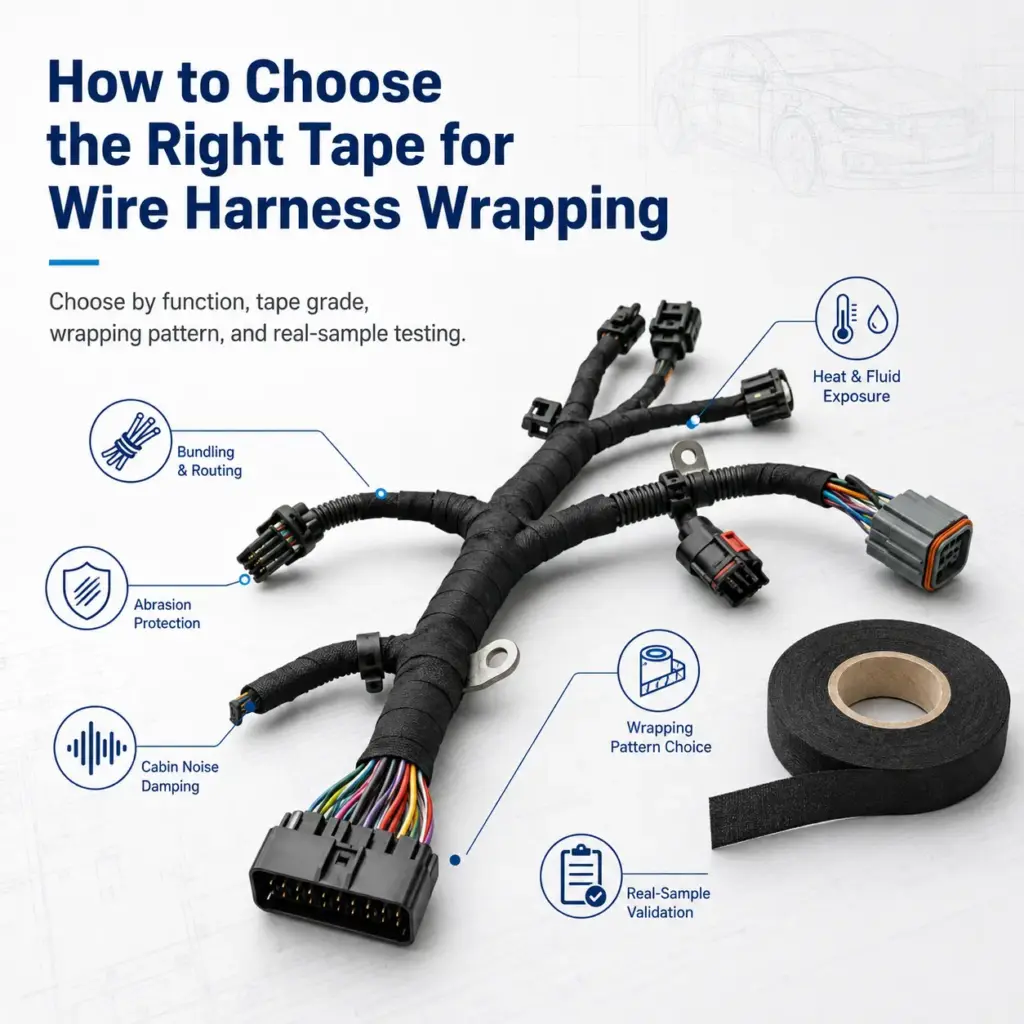
First decide what the finished wrap is supposed to do. The PVC-versus-cloth question comes later.
Bundling and routing
If the job is to hold wires together and maintain a defined route, you may not need the thickest or most abrasion-resistant construction. The tape still has to adhere consistently, follow the harness and leave a bundle that fits the installation space.
Check how the tape behaves around small diameters, branches, connector exits and changes in bundle size. A tape that works on a straight trunk may wrinkle or lift where the geometry changes.
Abrasion protection
Mark every point where the harness can contact sheet metal, brackets, housings or moving parts. The backing name is not an abrasion rating. Results also depend on the exact tape, number of layers, wrapping pattern and contact condition.
You may also need a sleeve, conduit or local protector when the contact is severe. Tape should not be used to hide a routing problem that ought to be corrected mechanically.
Noise damping
Behind cabin trim, inside doors, under instrument panels and in equipment enclosures, wires may tap or rub against nearby surfaces. Soft fleece, nonwoven, felt or velour constructions are often shortlisted because they add cushioning. Noise performance still depends on the exact construction, coverage and installation condition.
Check the finished outside diameter as well. Added cushioning can solve a noise problem but make the harness too bulky for a clip, channel or narrow assembly space.
Heat, fluids and outdoor exposure
For an engine compartment, industrial machine or exposed installation, write down the actual environment before choosing a tape. That may include continuous and peak temperature, oil, fuel, cleaning agents, moisture, ultraviolet exposure and thermal cycling.
Do not describe a whole tape family as high temperature or chemical resistant. Ask for the current technical data for the exact grade, then confirm that its test method and duration match your project requirement.
Special electrical, flame or shielding requirements
Electrical insulation, flame behavior, low-smoke performance and electromagnetic shielding are product-level or system-level properties. A material name does not prove compliance. Confirm the required standard, test method and acceptance limit.
If a conductive foil or another special tape is involved, treat equipment compatibility as unconfirmed until the actual roll has been reviewed and tested.
Compare common wire harness tape families
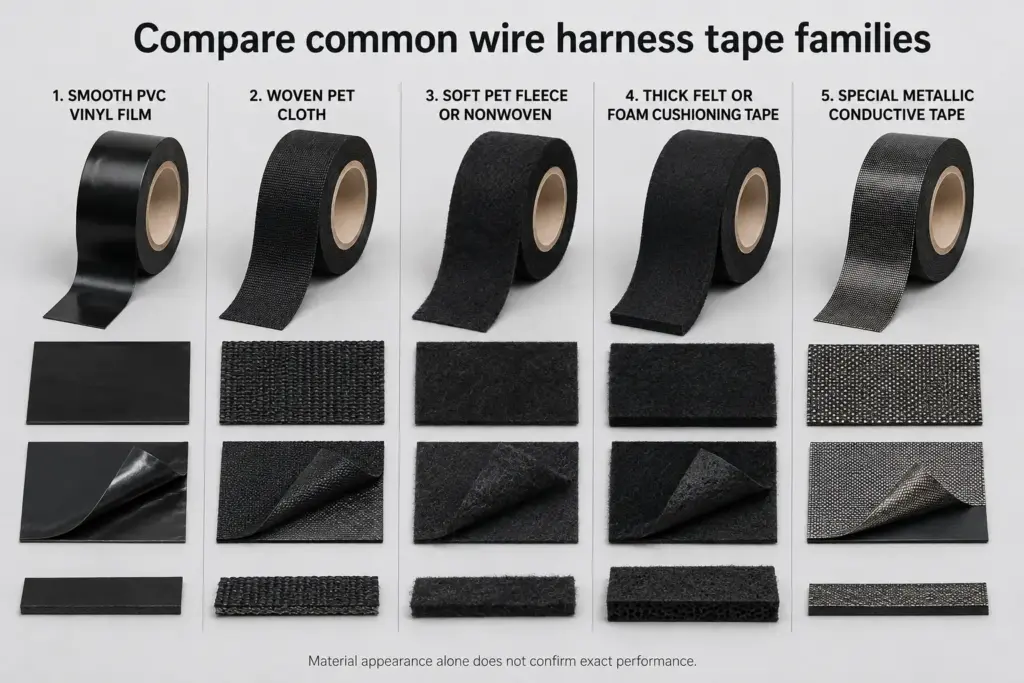
Use the material families below to build a shortlist. Approval still applies to the exact product grade, not the family name.
| Tape family | Why you may shortlist it | What you still need to verify | Process concern |
|---|---|---|---|
| PVC or vinyl film tape | General bundling, conformability and compact wrapping | Exact temperature range, adhesive, flame or electrical properties, aging and fluid resistance | Stretch, unwind force, tension control and cut behavior |
| Woven PET or PA cloth tape | Abrasion protection and a robust fabric backing | Exact abrasion class, temperature range, adhesive system, thickness and edge behavior | Higher unwind or cutting demand may apply, depending on the grade |
| PET fleece, nonwoven or velour tape | Noise damping, cushioning and flexible covering | Noise class or test method, thickness, compression, adhesion and aging | Finished diameter, compression and reliable cutting |
| Felt or foam cushioning tape | Local cushioning and gap filling | Compression set, temperature, fluids, adhesion and long-term thickness | Bulk, feed stability and cut method |
| Foil, conductive or other special tape | Shielding or another defined technical function | Electrical performance, construction, liner, grounding method and applicable standard | Liner handling, sharp edges, feeding and tool compatibility |
If the customer has already approved a tape grade, use it as the starting point. Otherwise, compare candidate data sheets against one requirement sheet. A broad marketing description is not a substitute for an engineering requirement.
Match the tape to the harness location
Map the harness by installation zone. A single assembly may need more than one tape because its trunk, branches and exposed sections do not necessarily face the same conditions.
| Harness location | Questions to ask before selecting tape |
|---|---|
| Cabin, trim or instrument panel | Can the harness contact a hard surface and create noise? How much added thickness can the installation accept? |
| Door, hinge or moving section | How often does the bundle flex? Could the tape stiffen the bend or lift near the moving point? |
| Engine compartment or hot equipment | What are the continuous and peak temperatures? Which oils, fuels, coolants or cleaners may contact the tape? |
| Underbody, exterior or exposed machinery | Is there moisture, grit, ultraviolet exposure, abrasion or impact? Is tape enough, or is another protective component required? |
| Appliance, cabinet or general internal routing | Is the main need bundling, appearance, electrical insulation, flame behavior or process consistency? |
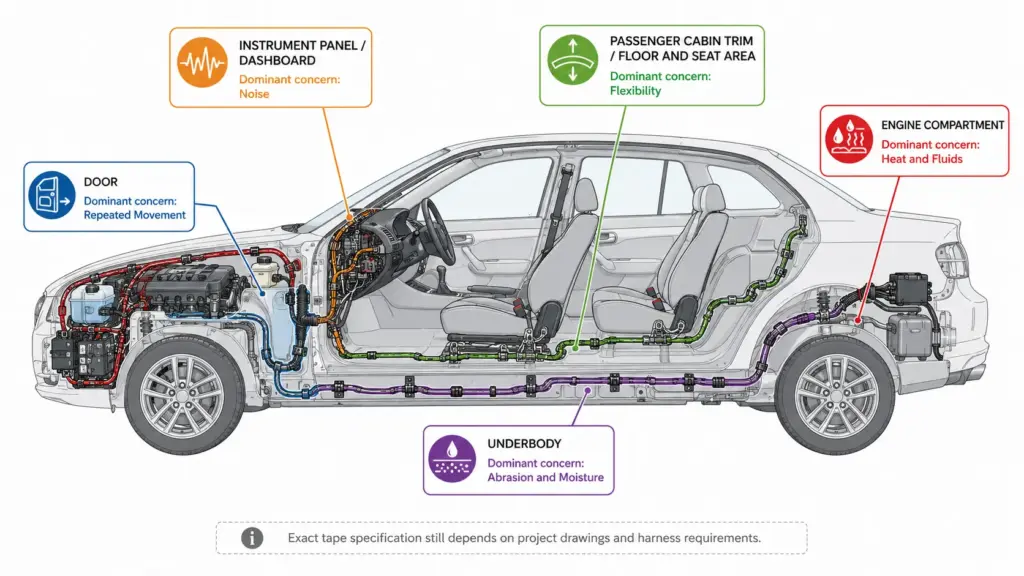
Map those zones on the drawing. A local abrasion point may need a different construction from the rest of the bundle. A cabin section may need cushioning while a narrow connector route needs a thinner wrap. Treating the whole harness as one environment often produces either weak protection or unnecessary material use.
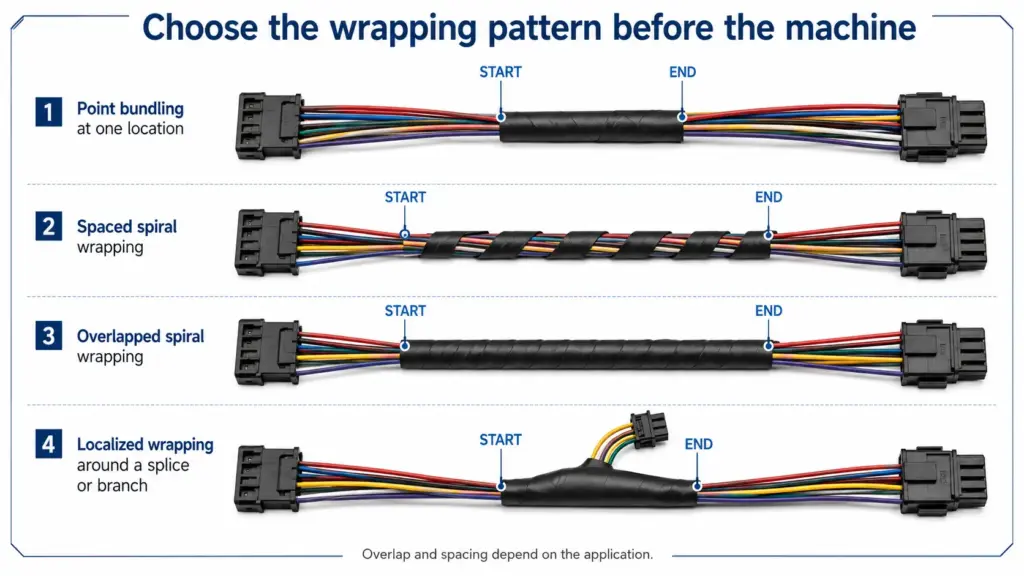
Choose the wrapping pattern before the machine
Decide the wrapping pattern before discussing equipment. The choice changes tape consumption, bundle stiffness, coverage and cycle time.
Point bundling
Point bundling secures wires at selected positions instead of covering the full harness. Record the location, number of turns, start condition and end condition.
Spaced spiral wrapping
A spaced spiral leaves gaps between turns. It can reduce tape use and preserve flexibility, but it does not provide continuous surface coverage. Specify pitch or gap in the drawing so the result does not depend on operator judgment.
Overlapped or full-coverage wrapping
An overlapped spiral gives more continuous coverage. The required overlap must come from the customer drawing, tape specification or validated process. There is no universal overlap percentage that is correct for every tape and harness.
More overlap also adds material and can increase the finished diameter or stiffness. Check clips, channels, grommets and bend areas after wrapping.
Branches, splices and connector exits
These areas expose weaknesses that a straight sample may not reveal. Define where the wrap starts and stops, how a branch is opened, whether a splice needs local protection and how close the tape may approach a connector. The machine or work method must reproduce these details without damaging the wires or obstructing assembly.
Check the tape roll as well as the tape material
An approved tape can still be a poor process fit if its roll format is wrong for the equipment. Collect these details from the production roll:
- Supplier and exact product grade
- Backing and adhesive type
- Tape width and total thickness
- Roll outside diameter and core inside diameter
- Roll orientation and any release liner
- Unwind force or observed unwind behavior
- Whether the tape is hand tearable or requires a cutter
- Storage condition and shelf-life instructions supplied with the product
For the harness, record:
- Minimum and maximum bundle diameter
- Harness length and weight
- Number and position of branches, splices and connectors
- Smallest bend and most difficult geometry
- Required pattern, pitch or overlap
- Start and end requirements
- Acceptable final diameter and flexibility
- Target batch size, cycle time and inspection criteria
Small differences matter. A wider tape changes the number of turns. A thick fleece changes the finished diameter. A liner changes feeding and waste handling. A strong unwind force may require different tension control from a soft film tape. These are process inputs, not minor purchasing details.
Match the selected tape to the wrapping process
Choose the process route after you have an exact tape grade and a defined wrapping pattern. Sedeke groups its wire harness taping machines by localized bundling, programmed or continuous wrapping, handheld wrapping and tape preparation.
A short point wrap does not create the same handling problem as a long straight trunk or a branched, low-volume harness. Use the category page to narrow the equipment family rather than turning tape selection into a model comparison.
Selected Sedeke product pages list PVC, cloth, felt or similar materials. That does not mean every grade in one of those families will run on every model. Tape width, thickness, core, roll diameter, unwind behavior and cutting demand vary, so compatibility must be checked with the production tape and a harness sample.
Validate the tape and wrapping process with real samples
A data sheet can justify a test, but it cannot show how the production roll will behave on your harness.
Use the real tape grade, production roll format and a representative harness. Include the largest and smallest diameters, branches, connectors, splices and difficult bend areas. If production variation is wide, test the worst-case samples rather than one easy straight bundle.
Review the sample in this order:
- Check whether the tape anchors without excessive handling or exposed adhesive.
- Compare the pitch, overlap or point-wrap position with the drawing.
- Look for wrinkles, folds, gaps, stretched film and damaged backing.
- Inspect branches, diameter changes and the final cut for lifting or flagging.
- Confirm that cutting does not pull the harness, leave loose fibers or create an unacceptable tail.
- Check wire twist, connector orientation, branch access and pressure on delicate components.
- Measure the final diameter where it affects clips, grommets, channels or installation clearance, then check the required flexibility.
- Run the aging, temperature, fluid, abrasion, noise or electrical tests required by the customer or applicable standard.
Retain the approved sample, tape identification and process settings. If the tape supplier changes the construction, roll format or adhesive, review whether revalidation is required. The same applies when the harness geometry or wrapping requirement changes.
What to send Sedeke for an application review
Do not start an application review with a model name alone. Send the production conditions Sedeke needs to assess the process:
- Tape supplier, exact grade and a sample roll
- Tape backing, adhesive, width and thickness
- Roll outside diameter, core inside diameter and liner information
- Harness drawing or clear sample photos
- Minimum and maximum bundle diameters
- Harness length, branches, connectors and splices
- Required point, spaced or overlapped wrapping pattern
- Pitch, overlap, start and end requirements where specified
- Environmental and customer qualification requirements
- Expected batch size, cycle target and acceptance criteria
If the tape grade has not been chosen, send the functional requirements and the candidate technical data instead of asking the machine supplier to assume a material. Sedeke can review the wrapping task and equipment route, while the tape manufacturer and your engineering team confirm the tape’s material performance.
Frequently asked questions
Is PVC or cloth tape better for a wire harness?
There is no universal winner. PVC or vinyl film may suit compact bundling and conformability, while cloth constructions may be candidates where abrasion or a fabric backing matters. Compare exact grades against your temperature, fluid, abrasion, flexibility and process requirements.
Which wire harness tape is best for noise reduction?
Fleece, nonwoven, felt or velour constructions are common candidates because they can cushion contact between the harness and nearby surfaces. Use the exact product rating or test method, then test the tape in the installed condition. Thickness and coverage can change the result.
Which tape should you use for abrasion protection?
Define the contact condition, required abrasion test and available space first. Cloth tapes may be candidates, but performance depends on the product and wrap construction. Severe contact may also call for a sleeve, conduit, edge protector or routing change.
Can you choose a high-temperature harness tape by backing material?
No. Temperature capability belongs to the complete tape construction and its stated test conditions. Check the exact backing, adhesive, continuous and peak limits, aging duration and any fluid exposure required by the project.
What overlap should you use for wire harness tape?
Use the overlap specified by the customer drawing, tape supplier or validated process. Do not apply a default percentage to every harness. Overlap affects coverage, material use, stiffness and finished diameter.
Can one wire harness taping machine run PVC, cloth and fleece tape?
Some Sedeke models list more than one material family, but the listing does not confirm every grade or roll format. Check tape width, thickness, roll and core dimensions, unwind behavior and cutting demand. Confirm the combination with a sample test.
How does tape width affect the wrapping process?
Tape width changes the number of turns, coverage at a given pitch, behavior around branches and the ability to follow small diameters. It can also affect machine fit. Use the width on the approved drawing or validate it with the harness geometry.
Why is a real sample test needed if you have the tape data sheet?
The data sheet describes the tape under stated conditions. It cannot show the production roll’s unwind behavior, cut quality, adhesion around branches, effect on bundle diameter or interaction with the selected equipment. You need the sample test to connect material selection with the production process.
Final thoughts
Finish the tape decision before confirming the equipment. Work from the function and environment to the exact tape grade, wrapping pattern and roll format, then validate the combination on the real harness.
When you ask Sedeke to review the application, provide the tape sample, roll dimensions, harness drawing and required wrapping pattern. Sedeke can then assess the process route and identify which points still need testing before production.