

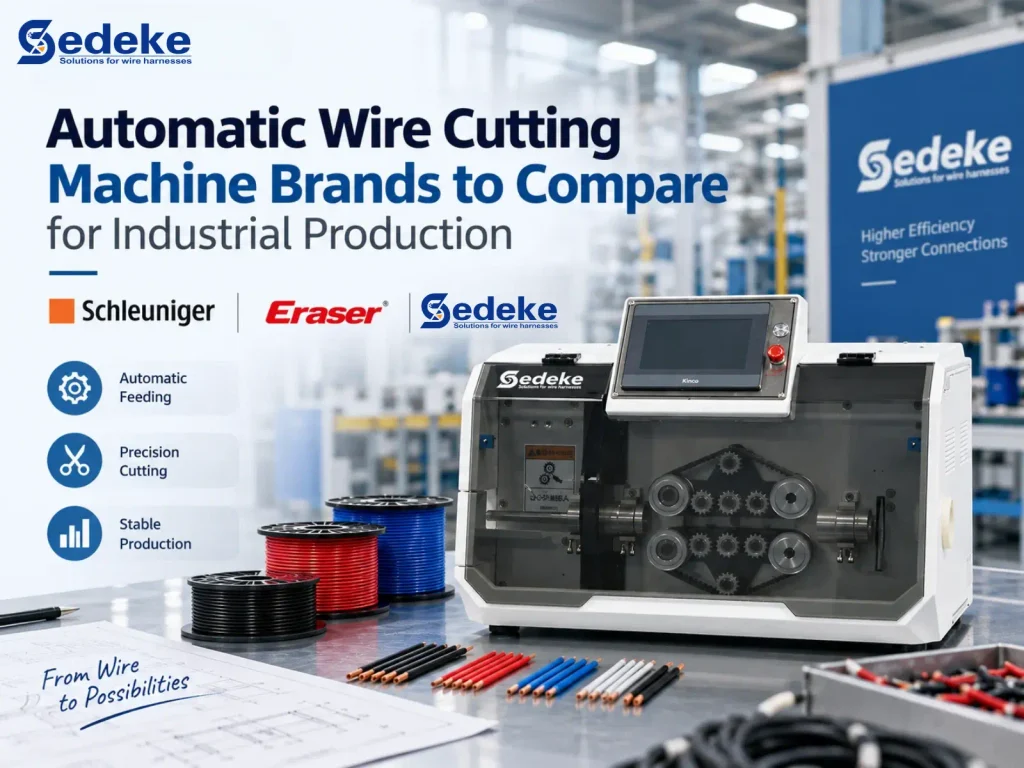
When you compare automatic wire cutting machine brands, start with the wire you need to process and the finished lengths you need to deliver. Schleuniger, Eraser and Sedeke have equipment worth investigating for this work, but the model and configuration determine whether a machine fits your production.
This guide covers automatic feeding and cutting to length for electrical wire and cable assembly. It excludes wire EDM, scrap-wire recycling and handheld cutters. You will find a short brand comparison, the questions to put to each supplier and a practical way to compare sample results before requesting a final quotation.
Sedeke prepared this guide using published product information. The examples form a shortlist, not a market-wide ranking or an independent performance test.
Start with a comparable cutting job
Write one application brief and send the same version to every supplier. Include the conductor material and construction, insulation, outside diameter, required cut lengths and acceptable length variation. State whether you need cut pieces only or stripped ends as well.
For example, a purchase request that says “cut cable automatically” leaves the end preparation unspecified. A machine that delivers cut pieces may meet that request even though your next operation needs exposed conductors. If stripping belongs in the same cycle, compare wire cutting and stripping machines as a separate equipment group.
Also describe how material reaches and leaves the machine. Send the reel dimensions and weight, and explain whether the cut pieces will fall into a tray or need controlled collection. Ask each supplier to quote the complete arrangement required for your job.
Three automatic wire cutting machine brands to compare
The examples below identify a starting point within each supplier’s range. Their catalog specifications do not establish equivalent capacity or performance on your material.
| Brand | Example to investigate | Published feature relevant to your shortlist | Question for your application |
|---|---|---|---|
| Schleuniger | EcoCut 3300 | Separate conductor limits for stranded and solid wire; interfaces for peripheral equipment | Does the proposed configuration handle your wire construction and required peripherals? |
| Eraser | WC302 | Programmable cutting with selectable feed rates and stored batches | Can the proposed setup produce your job mix at the required length tolerance? |
| Sedeke | EC-6800 | Wire cutting with interfaces for a prefeeder, printers and a PC | Which feeding, marking and collection components belong in your quotation? |
Schleuniger: EcoCut 3300
The EcoCut 3300 product page is now hosted by Komax Group. Its published conductor limits distinguish stranded wire, up to 16 mm², from solid wire, up to 6 mm². The page also separates standard and optional interfaces. These distinctions make it useful to review when your comparison includes different conductor constructions or peripheral connections. See the official EcoCut 3300 specifications.
Request a configuration for the actual material you will run. A conductor limit alone does not answer every question about the insulated cable or the equipment around the cutter.
Eraser: WC302
The WC302 is an automatic wire and flexible-tubing cutter. Eraser lists nine feed rates and storage for up to 99 batches. Its stated wire capacity distinguishes 12 AWG stranded wire from 14 AWG solid wire. The official WC302 page provides the model details.
If you run repeated batches, ask for a demonstration of job programming and changeover using your own lengths and quantities. Record the setup time as well as the cutting time. Confirm the exact model on the quote, since specifications elsewhere on a product-family page may describe another machine.
Sedeke: EC-6800
The Sedeke EC-6800 automatic cutting machine lists wire among its supported materials. Its product information includes a touchscreen, an air-blowing device and external interfaces for inkjet or laser printers, a PC and a prefeeder.
Consider it as a candidate when your enquiry includes both cutting and the equipment needed around that operation. Ask Sedeke to review the material, required lengths and marking or feeding requirements before selecting a configuration. An available interface does not mean every printer or feeder is included or compatible without further confirmation.
You can also review Sedeke’s automatic cutting machine range if your material calls for a different cutting arrangement.
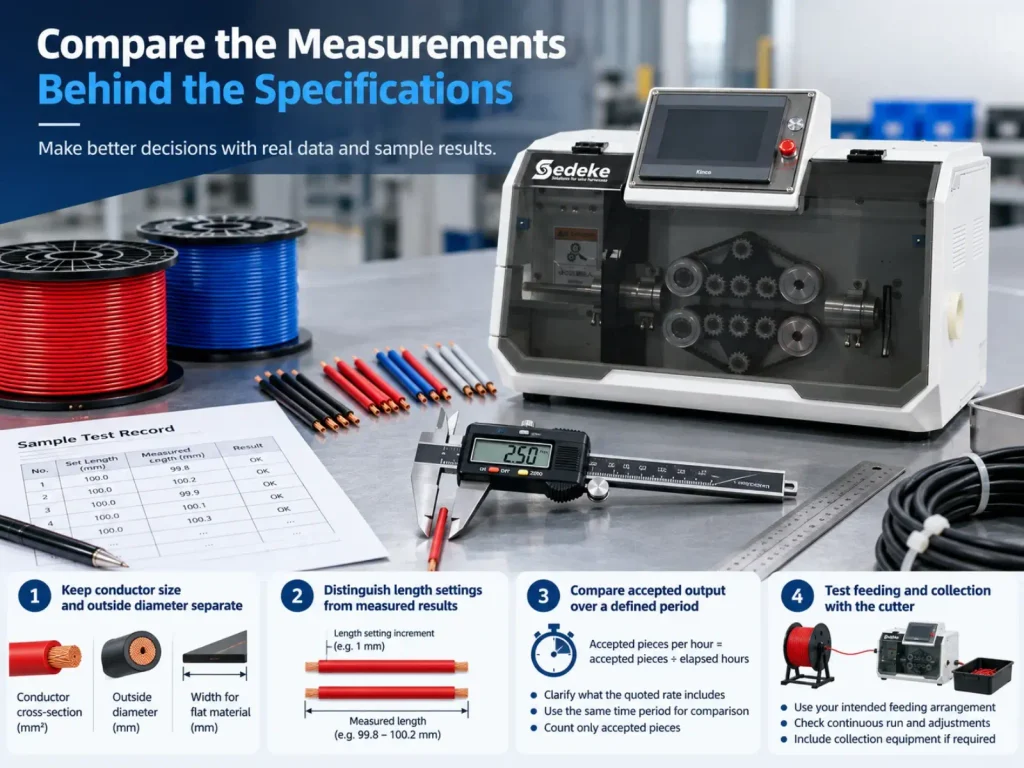
Compare the measurements behind the specifications
Keep conductor size and outside diameter separate
Record both values in your comparison sheet. Conductor cross-section describes the conductive material; outside diameter includes the cable’s outer dimensions. A width limit for flat material is another measurement again.
Keep solid and stranded conductors separate wherever the supplier does. Do not apply one material’s listed limit to another construction. Ask the supplier to identify the machine, guides and cutting setup used for your sample.
Distinguish length settings from measured results
A length-setting increment describes the step between selectable settings. It is not, by itself, a promise about the error in a finished piece.
For your sample trial, agree how cut length will be measured, the acceptance tolerance and the condition of the material during measurement. Ask for individual results across the agreed sample, rather than a single selected piece. The minimum, maximum and number of rejected pieces are more useful for your decision than an unexplained claim of “high precision.”
Compare accepted output over a defined period
Ask what a quoted production rate includes. Was the demonstration cutting only, or did it also include stripping, printing or another operation? What cut length and material were used? Were loading, changeover and rejected pieces counted?
For your own comparison, use:
Accepted pieces per hour = accepted pieces ÷ elapsed hours
Define the elapsed period consistently across trials. A result measured during uninterrupted cutting and a result measured across an entire shift describe different operating conditions.
Test feeding and collection with the cutter
Include the intended reel or feeding arrangement in the trial. Ask the supplier to show a continuous run and record adjustments, interruptions and visible marks on the insulation. If collection equipment is required, include it in the demonstrated setup.
A useful trial record identifies what was connected and what the operator did. This lets you distinguish the proposed production arrangement from a short demonstration with material already prepared beside the machine.
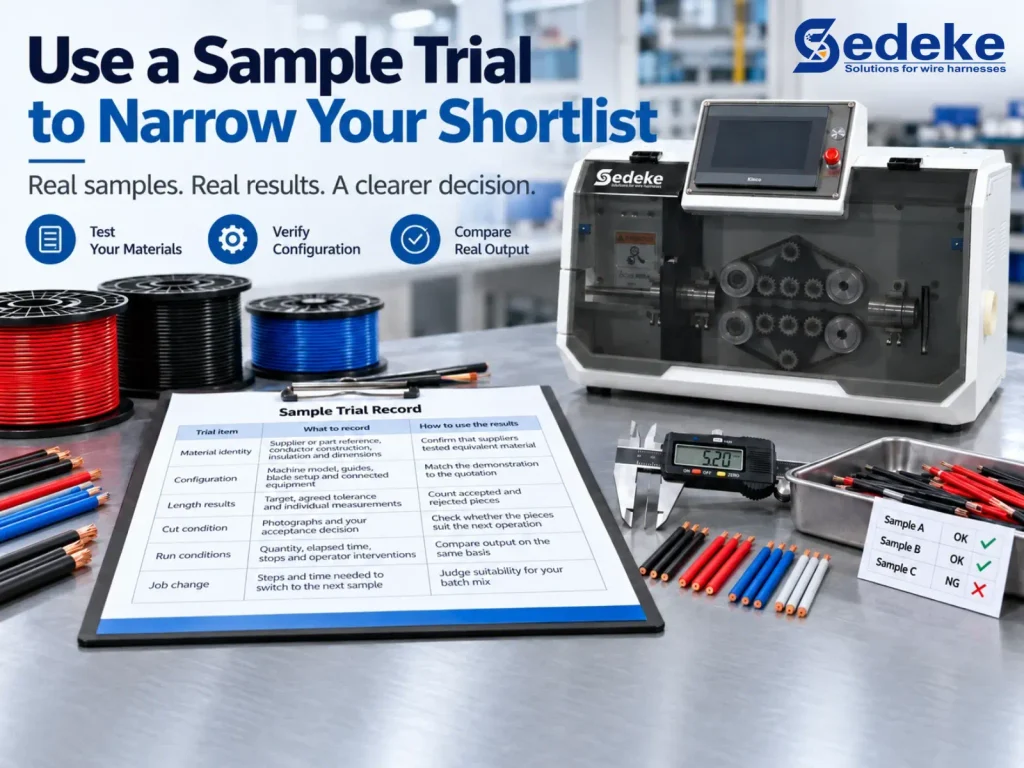
Use a sample trial to narrow your shortlist
Send samples that represent your normal job mix, including any material you already find difficult to process. Agree the sample quantity and acceptance criteria with your quality team and the supplier before testing.
Use the same record for each candidate:
| Trial item | What to record | How to use the result |
|---|---|---|
| Material identity | Supplier or part reference, conductor construction, insulation and dimensions | Confirm that suppliers tested equivalent material |
| Configuration | Machine model, guides, blade setup and connected equipment | Match the demonstration to the quotation |
| Length results | Target, agreed tolerance and individual measurements | Count accepted and rejected pieces |
| Cut condition | Photographs and your acceptance decision | Check whether the pieces suit the next operation |
| Run conditions | Quantity, elapsed time, stops and operator interventions | Compare output on the same basis |
| Job change | Steps and time needed to switch to the next sample | Judge suitability for your batch mix |
Choose the candidate that meets your defined acceptance criteria with a configuration you can operate and maintain. If several pass, compare their complete quotations. If none pass, ask suppliers to revise the configuration or narrow the stated application before ordering.
Compare quotations for the same scope
A low base-machine price is difficult to evaluate when the required accessories are missing. Ask every supplier to itemize the cutter, material guides, initial spare blades, feeding and collection equipment, and any marking hardware or software.
Confirm the electrical supply and any compressed-air requirements for the quoted configuration. Request written terms for training, spare parts, warranty coverage, delivery and support at your installation location. Avoid treating a general brand statement as the terms of your order.
You can separate your comparison into the delivered equipment price, installation and training costs, and expected operating expenses. Keep each estimate tied to an assumption or a supplier quotation. That gives your purchasing team a reason for the decision beyond the lowest headline price.
Request a cutting-machine quotation from Sedeke
Once you have defined the job, send Sedeke your application brief and request a configuration and current quotation. Include:
- Wire or cable specifications, photographs and representative samples where practical.
- Minimum and maximum cut lengths, required tolerance and the condition expected at the cut ends.
- Batch quantities, production targets and how often you change materials or lengths.
- Reel information, feeding and collection needs, and any printing or downstream processing requirements.
- Installation country, available utilities and your required delivery date.
Ask for the proposed model, included accessories, sample-review arrangements and quotation validity. This gives you a concrete Sedeke proposal to compare against the same requirements used for the other candidates.
Request a Sedeke cutting-machine quotation with your specifications and production requirements.
FAQ
How should you compare a distributor quote with a factory quote?
Check that both specify the same model and accessories. Then identify who will handle delivery, training, warranty claims and replacement parts. Request confirmation of the distributor’s authorization before treating the proposals as equivalent.
Can one demonstration cover every cable we use?
Treat it as evidence for the tested material and setup. If your range includes different conductor constructions, insulation or dimensions, agree which representative samples are needed before accepting broader coverage.
Should you buy a machine with extra capacity?
Ask what the additional capacity solves for your current work or a defined future requirement. Include the smaller jobs in the trial too, so you can assess the proposed machine against the full job mix.
What if a supplier will not quote until it receives samples?
Ask which application questions require a sample and whether a preliminary configuration can be discussed first. Keep any early price separate from the final quote until the equipment scope and acceptance requirements are agreed.
Can you use this comparison to select an EDM machine?
No. This shortlist covers machines that feed electrical wire or cable and cut it to length. You need a separate equipment comparison for wire EDM applications.
Final thoughts
A useful brand shortlist ends with comparable sample results and quotations. Keep the material, acceptance criteria and equipment scope consistent, then choose the proposal that fits your production requirements.
If Sedeke is on your shortlist, send the application details above for a model discussion and current quotation. Use the proposed configuration and agreed sample-review results to decide whether it belongs in your production plan.